



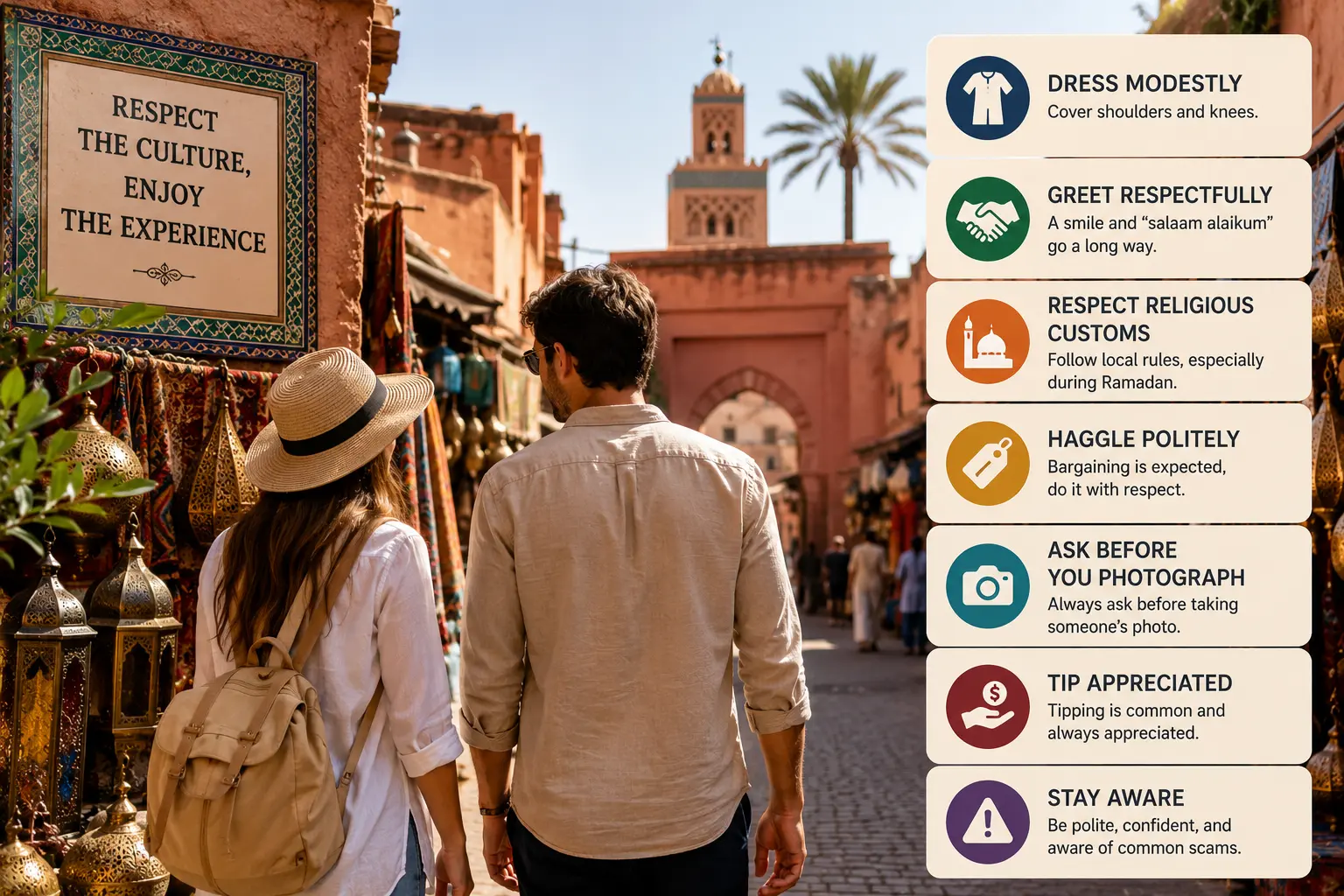
I have watched thousands of visitors pass through this city, and the ones who leave loving Marrakech are almost never the ones who researched the most museums or booked the fanciest riad. They are the ones who understood, even just a little, how things work here.
Morocco is warm and welcoming by nature, genuinely one of the friendliest countries you will visit, but it is also a Muslim country with its own rhythm, its own social rules, and its own version of politeness that does not always match what visitors expect from home.
This guide is not a list of scary warnings. It is what a local would actually tell you over a cup of mint tea before you head out into the medina, the small things that make the difference between being treated as just another tourist and being treated as a welcome guest. Get these basics right and the rest of your trip gets noticeably easier.
1. Dress Code in Marrakech
The Basic Rule for Everyone
Morocco places real value on modesty, and Marrakech, despite being one of the more relaxed cities in the country, still expects visitors to dress with a bit of care, especially inside the medina. A simple rule covers almost every situation, keep your shoulders and knees covered, and avoid anything see-through or overly tight. It is not about religious law forcing your hand, nobody will stop you at the airport, it is about basic respect for the neighborhood you are walking through, the same way you might dress differently for a quiet village at home than you would for a beach.
What Works Well for Women
Loose trousers, maxi dresses, and long skirts paired with a top that covers the shoulders all work beautifully and stay comfortable in the heat. A light scarf is worth packing too. Moroccan women are not legally required to cover their hair, and plenty do not. However, a scarf comes in handy if you visit a shrine or a conservative neighborhood. Save tank tops, short shorts, and low-cut blouses for your riad pool or a beach resort rather than the souks.
What Works Well for Men
Men have an easier time of it generally, but knee-length shorts are still a better call than the shortest gym shorts, and a plain t-shirt beats anything with an aggressive slogan. Long, breathable trousers are genuinely the most comfortable option once you are walking cobblestone alleys in the afternoon sun anyway, so dressing modestly and dressing practically usually end up being the same choice.
2. Greetings and Everyday Manners
A friendly “salaam alaikum,” meaning peace be upon you, goes a long way here, and the correct reply is “wa alaikum salaam.” You do not need to be fluent in Arabic or French to make a good impression, even five basic phrases genuinely change how shopkeepers and staff treat you throughout your stay.
Moroccans are naturally chatty and hospitable, and if a vendor asks where you are from or how your trip is going, that is usually a real conversation, not a sales tactic, so it is worth engaging rather than brushing past.
Mint tea deserves its own mention here, since it sits at the center of Moroccan hospitality. If you are offered a glass while browsing a shop or visiting someone’s home, accepting it is a polite and genuinely enjoyable part of the culture, even if you have no intention of buying anything that day.
3. Religious Sites and Ramadan Etiquette
Visiting Mosques
Most active mosques in Marrakech, including the famous Koutoubia, are not open to non-Muslim visitors, and this is simply how religious sites work across Morocco rather than something specific to tourists.
A small number of sites do offer guided visits for outside visitors, and if you do get the chance to enter one, remove your shoes at the entrance and dress conservatively, covering shoulders, knees, and for women, ideally your hair as well.
Traveling During Ramadan
If your trip lands during Ramadan, the atmosphere shifts noticeably. Many locals are fasting from sunrise to sunset. Eating or drinking openly in public during daylight hours, even just sipping water on a street corner, is considered disrespectful, even though restaurants serving tourists generally stay open.
Some shops and attractions also adjust their hours, opening later or closing earlier than usual, so it is worth checking specific opening times before you plan your day.
If you get the chance to join an iftar, the meal that breaks the fast at sunset, take it, it is one of the warmest and most memorable ways to experience Moroccan hospitality firsthand.
4. Haggling in the Souks
Bargaining is not just tolerated in the souks, it is expected, and treating it as a fun back-and-forth rather than a fight makes the whole experience better for everyone involved. A reasonable starting point is offering around half of the vendor’s initial asking price and negotiating up from there, adjusting based on how the conversation goes.
Keep the tone light and friendly rather than aggressive, insulting the merchandise or the seller rarely gets you a better deal and mostly just sours the interaction. If a price does not come down to your comfort level, simply smile, thank the vendor, and walk away. Sometimes that alone brings the price down further. Other times, it simply means the item was not meant for you.
One last thing worth knowing, only start haggling if you are genuinely interested in buying, opening a negotiation purely out of curiosity and then walking away wastes a shopkeeper’s time and is generally considered poor form.
5. Photography Etiquette
Marrakech is one of the most photogenic cities you will ever visit, but the etiquette around photographing people is worth understanding before you start snapping away.
Always ask before photographing a person directly, especially women, a smile and a simple gesture toward your camera usually gets you a clear yes or no without needing shared language. This applies doubly to performers in Jemaa el-Fna, including snake charmers, henna artists, and musicians. Many expect a small tip if you photograph their act. Not offering one after taking photos can create real tension.
Buildings, markets, and street scenes without identifiable faces are generally safe to shoot freely, so if you are unsure, aim your lens at the architecture and the color of the place rather than at a stranger’s face.
6. Avoiding Common Scams
The Fake Guide Approach
The most common scam in Marrakech is the unofficial guide. Someone approaches you near the medina or Jemaa el-Fna. They offer to walk with you or show a better route. They insist they want nothing in return. However, they demand payment once they decide enough time has passed.
Licensed guides always wear a visible official badge, and if someone offering help cannot produce one, politely decline and keep moving. Mentioning that you will speak to the police if they persist is usually enough to end the interaction.
Shops, Tanneries and Distraction Tricks
A related trick involves someone telling you that the street or attraction you are heading toward is closed, then offering to lead you somewhere else, often a shop or a tannery where they earn a commission on anything you buy.
If a location you are heading to is genuinely closed, you will find out at the door, there is rarely a real need for a stranger to intervene and redirect you first. When it comes to taxis, always confirm the meter is running before you set off, or agree on a fixed price beforehand, and be aware that fares are legally about fifty percent higher after dark, which is normal and not itself a scam.
7. Alcohol, Public Behavior and Physical Affection
Alcohol is legal and available in licensed restaurants, hotel bars, and clubs, but it is not sold or consumed openly on the street, and drinking in the medina’s public alleys is not appropriate.
Public displays of affection, including hand holding for unmarried couples in more traditional areas, are generally kept low-key here compared to what might be normal at home, and it is worth toning things down while walking through the medina and souks specifically, even if your hotel pool or a rooftop bar feels more relaxed.
Getting visibly drunk in public spaces, particularly around Jemaa el-Fna, tends to attract exactly the kind of attention you do not want, so save the heavier drinking for your riad or a proper nightlife venue rather than the street.
8. Tipping Etiquette
Tipping is customary throughout Marrakech and genuinely appreciated, since many service workers earn modest wages. At restaurants, ten percent of the bill is a fair tip if a service charge has not already been added.
Guides and drivers for a full day’s work typically receive somewhere between fifty and one hundred dirhams, and smaller services, a bag carried, a quick favor, a photo taken for a street performer, usually warrant a few dirhams handed over directly.
Carrying small bills and coins throughout the day makes this much easier, since most everyday transactions in Marrakech run on cash rather than card.
Take Away
None of this is meant to make you nervous about your trip. Marrakech is one of the most hospitable cities in the world, and the vast majority of interactions you have here, with shopkeepers, waiters, riad staff, and strangers on the street, will be genuinely warm.
Understanding these small customs just clears the path for that warmth to come through, instead of getting lost in a misunderstanding that neither side actually wanted. Dress with a bit of care, greet people properly, haggle with a smile, and the city will meet you more than halfway.
FAQs About Marrakech Etiquette
What should tourists avoid wearing in Marrakech?
Avoid short shorts, mini-skirts, low-cut or sleeveless tops, and see-through fabrics, especially inside the medina and souks. A simple rule of covering shoulders and knees works well for both men and women and keeps you comfortable while showing respect for local norms.
Is it rude to bargain in the souks?
No, bargaining is completely normal and expected in Marrakech’s markets. It only becomes a problem if it is done rudely, aggressively, or without any real intention to buy. Keep it friendly, start around half the asking price, and be ready to walk away if the number does not work for you.
Can tourists enter mosques in Marrakech?
Most active mosques, including the Koutoubia, are closed to non-Muslim visitors, which is standard practice across Morocco rather than something unique to tourists. A small number of sites offer guided access, and where that is available, modest dress and removing your shoes at the entrance are expected.
Is it safe to photograph people in Marrakech?
It is safe as long as you ask first. Many locals, especially women, do not want to be photographed without permission, and performers in Jemaa el-Fna typically expect a small tip if you take their picture. Buildings and general street scenes are generally fine to photograph freely.
How do I avoid the fake guide scam in Marrakech?
Politely decline any unsolicited offers of help near the medina entrances, and ask to see an official badge if someone claims to be a licensed guide. If you want a guide, arrange one through your riad or hotel rather than accepting an approach on the street.
Is drinking alcohol allowed in Marrakech?
Yes, alcohol is legal and served in licensed restaurants, hotel bars, and clubs. It is best kept to those settings rather than consumed in public on the street, out of respect for Morocco’s Islamic customs.
What is the polite way to greet someone in Marrakech?
A simple “salaam alaikum,” meaning peace be upon you, is warmly received, with “wa alaikum salaam” as the typical reply. Learning even a handful of Arabic or French phrases tends to noticeably improve how you are treated by shopkeepers and staff.
How much should I tip in Marrakech?
Around ten percent at restaurants if service is not already included, fifty to one hundred dirhams for a guide or driver’s full day of work, and a few dirhams for smaller favors or services. Carrying small cash throughout the day makes tipping much easier since most transactions here run on cash.


