



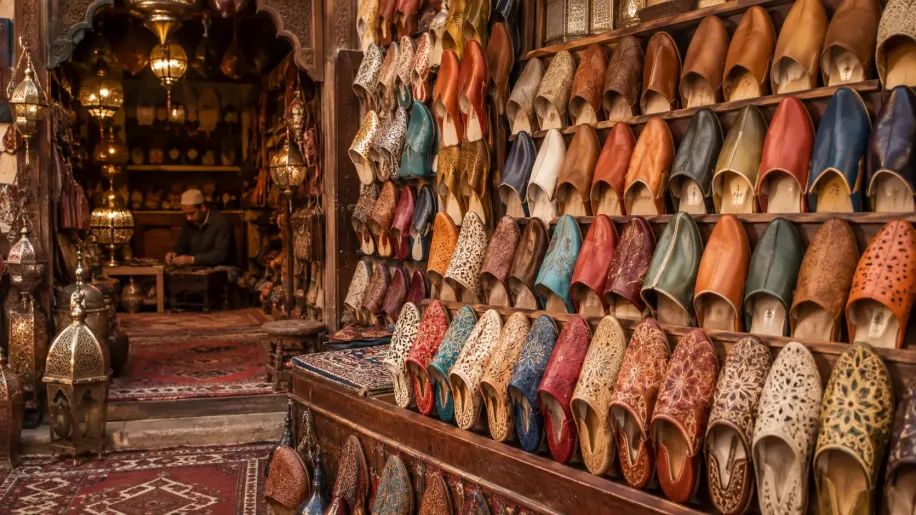
The best babouche shops in Marrakech are in Souk Smata, known locally as the “Souk of the Babouches,” where dozens of stalls sell nothing but slippers in every color and style. For fixed prices without any haggling, Ensemble Artisanal is the easier stop.
Both give you a genuine pair of traditional Moroccan slippers, but the shopping experience is completely different at each one.
My uncle has resoled the same pair of babouches three times since he bought them in this souk. That is the thing about real leather here. It lasts, and it molds to your foot the longer you wear it. Marrakech slipper shopping is not just picking a color off a shelf. It is finding a pair made the way they have always been made, by hand, from real hide.
Quick Facts Before You Shop
- Best areas: Souk Smata, Souk el Kebir, Souk Cherratin, and Ensemble Artisanal
- Price range: 60 to 150 MAD for a solid everyday pair, 200 MAD and up for embroidered or Gueliz boutique styles
- Best time to shop: Morning, when stalls are less crowded and shopkeepers have more patience to negotiate
- Bargaining: Expected in the souks, not needed at Ensemble Artisanal or Gueliz boutiques
- Sizing tip: Babouches run narrow, so try both feet and expect a short break-in period
What Makes a Traditional Moroccan Slipper
A real babouche is made from a single piece of leather, stitched by hand around a flat leather sole. The classic style has a pointed toe and no back heel, so it slides on and off easily. Some pairs are left plain, while others get embroidery, sequins, or contrast stitching along the seam.
Quality Moroccan leather slippers Marrakech artisans make should smell like real hide, not like glue or plastic. The leather should feel slightly stiff at first, since it needs a few wears to soften and shape itself to your foot. Cheap versions made of coated cloth or thin synthetic leather feel light and floppy from the very first touch.
Where to Buy Babouche Slippers in Marrakech
You can find best baboche slipper in Marrakech at these places:
Souk Smata
This is the heart of babouche slippers Marrakech shopping, and locals simply call it the shoe souk. Souk Smata sits within the wider network of Souk Semmarine, close to Jemaa el-Fna, and it is packed almost entirely with babouche shops Marrakech shoppers have relied on for generations.
Here you will find every color imaginable, from plain camel and black to bright yellow, turquoise, and deep red. Some stalls specialize in men’s styles with a low, closed heel, while others focus on women’s pairs with embroidery or sequins. Take your time, since the selection changes from stall to stall even within the same short alley.
Souk el Kebir and Souk Cherratin
Just beside Souk Smata, these two souks hold the largest concentration of leather workshops in the medina. This is where you can buy babouches in Marrakech straight from the artisans who cut and stitch them, often in small workshops behind the storefront.
Because the leather is worked on site, you can ask to see raw hides or watch a pair being finished. Prices here run close to Souk Smata, and negotiating tends to go a little easier if you show genuine interest in the craft rather than rushing the sale.
Ensemble Artisanal
For travelers who want a simple, no-haggling experience, Ensemble Artisanal on Avenue Mohammed V is the easiest option for Moroccan slippers Marrakech shopping. Prices are fixed and clearly marked, and every pair passes a basic quality check before it reaches the shelf.
You will usually pay a bit more here than the lowest souk price, but it is a reliable way to understand fair pricing before you head into the medina to bargain elsewhere.
Gueliz Boutique Shoe Shops
The new town district of Gueliz has shoe shops selling a more refined, higher-end pair of babouches, often in soft suede or dyed leather with cleaner stitching. This is a good stop if you want a polished gift or a pair that leans more fashion than souvenir.
Expect prices well above the souk range, but the fit and finish are usually more consistent, which matters if you are buying for someone who has never worn babouches before.
How to Spot a Quality Pair
A few quick checks separate a lasting pair from one that falls apart within a season.
- Smell the leather: Real hide has a natural, slightly earthy scent, not a chemical one.
- Bend the sole: It should flex easily but spring back into shape, not crease and stay creased.
- Check the stitching: Even, tight stitches along the seam signal careful handwork.
- Press the toe: A well-made babouche holds its point without collapsing when you press down.
- Compare weight: Genuine leather feels slightly heavier than the coated synthetic versions sold at tourist-heavy stalls.
Bargaining Tips for Babouche Shopping
Haggling here is simply how business works, not an attempt to overcharge you. A fair starting counter is around half the first price quoted, moving toward the middle as the conversation continues. Buying two or three pairs at once, especially for gifts, almost always gets you a better price per pair than buying just one.
Staying friendly and patient works better than rushing. Many shopkeepers will lower the price on their own once they see you are ready to walk toward another stall.
Sizing and Fit Tips
Babouches are cut narrower than most Western shoes, so always try on both the left and right pair, since handmade sizing can vary slightly. Expect a short break-in period of a few wears before the leather softens fully. If you are buying as a gift and unsure of the size, a slightly looser fit is easier to adjust than a tight one.
Frequently Asked Questions
Where are the best babouche shops in Marrakech?
Souk Smata has the largest selection and the most competitive prices. Ensemble Artisanal is the best choice if you prefer fixed prices without bargaining.
How much do babouche slippers cost in Marrakech?
A solid everyday pair runs 60 to 150 MAD in the souks. Embroidered styles or Gueliz boutique pairs can cost 200 MAD or more.
What is the difference between souk babouches and boutique babouches?
Souk pairs are handmade by local artisans at lower prices and require bargaining. Boutique pairs in Gueliz cost more but offer more consistent sizing and finish.
Do babouche slippers need to be broken in?
Yes. Real leather babouches feel slightly stiff at first and soften with wear, usually within the first few uses.
How can I tell if a pair of babouches is genuine leather?
Check the smell, the flexibility of the sole, and the weight. Genuine traditional Moroccan slippers feel heavier and smell like natural hide, while synthetic versions feel light and stiff.


