



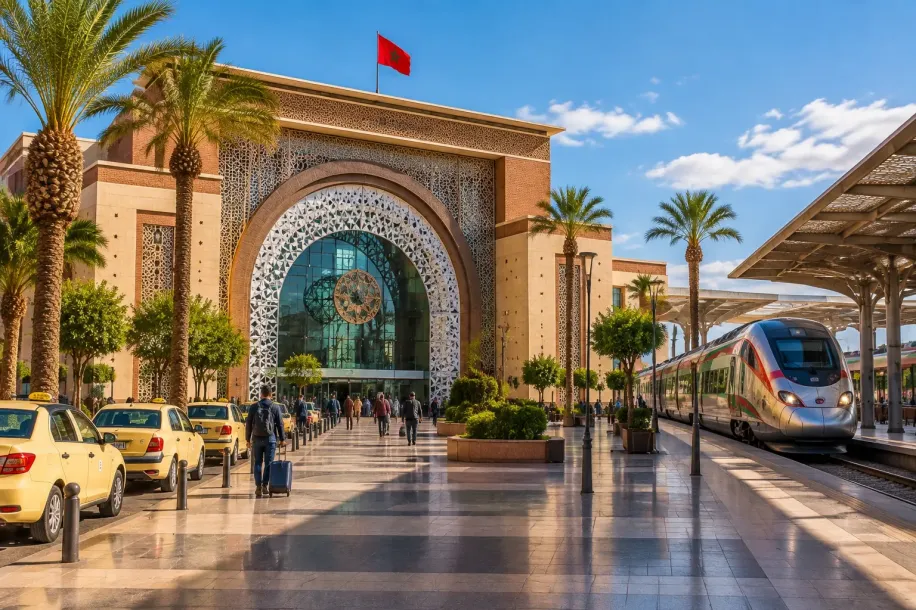
The building surprises people. Most travellers step out of a taxi expecting a functional transport shed and find a wide arched facade in carved stone and glass that looks more like a museum entrance. It opened in August 2008, next to the modest 1923 original that still stands beside it.
What the facade does not prepare you for is the taxi rank outside. That is where most first-time arrivals lose 40 dirhams and ten minutes of goodwill, and it is entirely avoidable.
This Marrakech train station guide covers the layout, the ticket process, current construction disruption, realistic taxi fares, and the small practical things that make the difference between a smooth departure and a stressful one.
Where Is Marrakech Train Station Located?
The station sits in Gueliz, the new city, at the junction of Avenue Hassan II and Avenue Mohammed VI. Anyone asking where Marrakech train station is located in relation to the old city can use this rule: it is roughly 1.5 to 2 kilometres northwest of Jemaa el-Fna, about a 25 to 30 minute walk.
Locals rarely say “train station” in English. Ask for Gare de Marrakech or Gare ONCF and every taxi driver in the city will know it.
A few orientation points:
- The Royal Theatre stands directly opposite the station forecourt.
- Avenue Mohammed V, the main Gueliz artery, runs from the station area down towards the Koutoubia and the medina.
- The Supratours bus terminal is attached to the same complex, not a separate site across town.
- Marrakech is the southern terminus of the national network. Nothing runs further south by rail.
Construction Disruption: What to Check Before You Travel
Check ONCF’s service notices before every journey in 2026. This is the single most important line in this guide right now.
The Kenitra to Marrakech high-speed line has been under construction since King Mohammed VI launched the works in April 2025. It is a 430 kilometre extension of the existing Al Boraq route, targeted for completion before the end of 2029 ahead of the 2030 World Cup. When it opens, Casablanca to Marrakech drops to roughly 90 minutes and Tangier to Marrakech to about 2 hours 40.
Until then, the works cause real disruption. Recent examples show the pattern:
- In April 2026, no trains served the station at all for roughly 48 hours. All arrivals and departures were moved to Sidi Brahim station, with replacement coaches shuttling passengers into the city.
- ONCF applied further route changes on 5 and 6 September 2026, affecting several lines and warning of delays to Al Atlas services.
- A revised transport plan took effect from 14 September 2026, involving schedule changes, shortened routes, and the phased closure of some stations.
None of this makes Marrakech train travel unworkable. It does mean you should not book a tight onward connection, and you should verify your specific departure on the ONCF app or website within 24 hours of travelling. ONCF publishes disruption notices through its site, app, customer centre, WhatsApp channel, and station staff.
Note also that Al Boraq high-speed trains do not currently reach Marrakech. Any site quoting Al Boraq fares to Marrakech is wrong. The service here is Al Atlas, the conventional intercity network.
How to Buy Train Tickets at Marrakech Station
Book online in advance if you can, and use the counters only as a fallback. This is the practical answer to how to buy train tickets at Marrakech station without losing half an hour.
You have four options:
The ONCF website or mobile app
Book at oncf.ma up to several weeks ahead. You receive a QR code, so nothing needs printing. Be aware that some travellers report the site blocking access from certain countries and rejecting foreign cards. Try a different card or the app if the website fails.
Staffed ticket counters
Multiple windows in the main hall. Queues build sharply in the hour before popular departures and around Moroccan holidays.
Self-service kiosks
Faster than the counters when they are working. The interface runs in Arabic and French.
Travel agencies in Gueliz
Useful if your card keeps failing online.
Practical points on Marrakech train station tickets:
- Bring cash in dirhams if buying at the counter. Card acceptance is inconsistent and exact change speeds everything up.
- Fares are dynamically priced. Booking early is genuinely cheaper, and last-minute fares can run considerably higher.
- Trains sell out on Fridays, Sundays, and around public holidays. First class fills first.
- Children aged 0 to 3 travel free on Moroccan trains.
- Second class seating is not always allocated on every service. First class gives you a reserved seat, which matters on long runs.
Ticket Prices and Journey Times From Marrakech
| Destination | Typical journey time | 2nd class | 1st class |
| Casablanca (Casa Voyageurs) | 2h40 to 3h20 | 49 to 139 MAD | 120 to 200 MAD |
| Rabat | around 4h | 90 to 180 MAD | 140 to 250 MAD |
| Fes | 6h30 to 7h | around 204 MAD | around 340 MAD |
| Tangier (via Casablanca) | around 5h15 | varies by connection | varies by connection |
| Tangier (direct overnight) | overnight | around 216 MAD seat | from 375 MAD couchette |
Read these as ranges, not fixed prices. ONCF uses variable pricing, so the same seat costs different amounts depending on how far ahead you book, the day, and demand. Advance fares to Casablanca can start near 49 MAD, while a last-minute peak booking can land far higher. Confirm current fares on the ONCF site before you travel.
Casablanca is the workhorse route, with roughly ten or more departures daily spread from early morning to late evening. There is no direct east to west line, so Fes and Meknes services route through Casablanca.
Is Marrakech Train Station Easy to Navigate?
Yes, and unusually so by international standards. Anyone wondering if the Marrakech train station is easy to navigate can relax. The whole building works on a single level, with one main hall, and platforms are a short walk from the concourse.
The sequence is simple:
- Enter through the glass doors facing Avenue Hassan II into the main hall.
- Ticket counters and kiosks sit along one side of the hall.
- Electronic departure boards display train numbers, destinations, times, and platform assignments in Arabic and French.
- Platform numbers appear on the boards shortly before departure, not hours ahead. Wait in the hall rather than guessing.
- Ticket validation machines sit near the entrance to the platforms.
- Ramps and lifts serve passengers with reduced mobility.
The station has only a handful of platforms, so there is no risk of a long cross-terminal sprint. Signage is in Arabic and French rather than English, but the layout is intuitive enough that this rarely causes problems.
How Early Should I Arrive at Marrakech Train Station?
Arrive 30 minutes before departure if you already hold a ticket, and 60 minutes if you still need to buy one. That is the honest answer to how early should I arrive at Marrakech train station, and it accounts for the counter queue rather than the walk to the platform.
Adjust upward in three situations:
-
Peak periods
Friday afternoons, Sunday evenings, Moroccan public holidays, and the Eid travel weeks. Add another 30 minutes.
-
During active LGV disruption
If your service has been rerouted or replaced by a coach transfer, build in an extra hour.
-
Large groups or families with young children
Boarding on unallocated second class seating goes better when you are early enough to sit together.
You do not need airport-style margins. There is no check-in and security screening is light.
Marrakech Train Station Facilities
The building is well equipped, which makes waiting genuinely comfortable. The Marrakech train station facilities cover most needs without leaving the complex:
- Food and drink. Cafés, snack bars, and international fast food outlets including McDonald’s and KFC.
- Shops. A small retail parade selling drinks, snacks, and travel basics.
- ATMs and bank counters. Withdraw dirhams here before heading into the medina, where cash is still king.
- Free Wi-Fi. Available in the public areas.
- Toilets. Usually a small charge. Keep coins.
- Prayer rooms. Provided within the station.
- Police post. On site, which contributes to the station’s reputation as safe for solo travellers.
- Waiting areas. Spacious, seated, and air conditioned.
- Real-time information boards. For arrivals, departures, and platform allocations.
One notable gap: there is no dependable left-luggage counter. Do not build a plan around storing bags here. Confirm on arrival if you need to, but assume the answer is no.
Marrakech Train Station Luggage Tips
Pack for stairs, gravel, and narrow train aisles rather than for smooth terminal floors. The most useful Marrakech train station luggage tips all come down to the same thing: you carry your own bags the entire way.
-
There are no porters and no baggage check
Everything you bring, you lift onto the train yourself.
-
Overhead racks are modest
Large hard-shell cases often will not fit and end up in the vestibule at the carriage end.
-
Board early on unallocated services
Late boarders find the racks full.
-
Keep valuables on your person
Bags sitting in the vestibule are out of sight for hours on the Fes run.
-
Soft-sided bags travel better
They compress into racks that rigid cases cannot.
-
The medina is not wheeled-luggage friendly
Once you leave the taxi, expect uneven ground, steps, and alleys too narrow for two people abreast.
-
Store bags in the city, not at the station
Use your riad or a dedicated luggage storage service if you have a gap between checkout and departure.
How to Get From Marrakech Station to Medina
A petit taxi is the fastest option and takes 10 to 15 minutes in normal traffic. For anyone working out how to get from Marrakech station to Medina, there are four realistic choices.
Petit taxi: The beige local taxis. Fastest and cheapest for a direct door-to-door run. Full fare detail below.
City bus: Routes running along Avenue Mohammed V connect Gueliz with the Koutoubia and Jemaa el-Fna area. Fares are a few dirhams. Slower, but perfectly usable with light luggage.
On foot: Around 25 to 30 minutes, mostly straight down Avenue Mohammed V towards the Koutoubia minaret, then on to Jemaa el-Fna. Pleasant in spring and autumn, punishing in July and August, and awkward with heavy bags.
Pre-booked riad transfer: Worth arranging if your riad is deep in the medina. Many alleys are unreachable by car, and a riad will usually send someone with a cart to meet you at the nearest vehicle access point.
Marrakech Train Station Taxi Price: What You Should Pay
Expect 20 to 40 dirhams to the medina on the meter in daytime. The honest reality of the Marrakech train station taxi price is that drivers at the station frequently decline the meter and open at 50 to 100 dirhams for the same trip.
How to handle it:
- Ask for the meter first. Say “compteur, s’il vous plaît.” Many drivers will simply switch it on.
- Agree a price before getting in if the meter is refused. Around 30 to 50 dirhams to the medina is a fair negotiated figure.
- Expect a legitimate night surcharge. Fares rise by roughly half after about 8pm. That increase is standard, not a scam.
- Petit taxis officially carry up to three passengers. Larger groups need two taxis or a grand taxi.
- Walk 100 metres from the rank if quotes stay high. A passing taxi on the avenue is usually more willing to run the meter.
- Carry small notes. Drivers routinely have no change for a 200 dirham note.
For the airport, buses stop directly in front of the main entrance, though there is no marked stop. You wait on the street and flag the bus as it approaches. Airport taxis operate on set tariffs that run higher than city trips.
A Short Note for First-Time Arrivals
If this is your first Moroccan rail journey, treat this Marrakech train station first time visitor guide as three rules rather than a long checklist.
Book online, arrive 30 minutes early, and settle the taxi fare before your bags go in the boot. Everything else at ONCF Marrakech station is straightforward: the hall is calm, the staff are helpful, and the trains are comfortable and generally punctual.
The one active variable is the high-speed line construction. Check your service the day before you travel and the rest takes care of itself.
Marrakech railway station is, on balance, one of the easiest major transport hubs in the country to use. The chaos people brace for is not here. It is waiting cheerfully for you in the souks, about 20 minutes down the road.
Frequently Asked Questions
What time does the station open and close?
The station operates through the day from early morning until late evening, broadly tracking the first and last train services. Overnight departures to Tangier mean the building stays active later than a standard closing time suggests. Check your specific departure rather than relying on general opening hours.
Can I use a foreign credit card to book online?
Sometimes. Travellers regularly report foreign cards being declined on the ONCF payment page, and the website is inaccessible from some countries. Try the mobile app, try a second card, and keep enough cash in dirhams as a backup for buying at the counter.
Do I need to print my ticket?
No. Online bookings generate a QR code that staff scan from your phone. Screenshot it before you travel, since station Wi-Fi and mobile data are not guaranteed to cooperate at the moment you need them.
Is the station safe at night?
It is generally considered safe, including for solo travellers. There is a police post on site, the building is well lit, and it stays busy with a mix of business travellers and tourists. Standard city awareness applies outside the building, particularly around the taxi rank.
Are there trains to Essaouira or Agadir?
No. Marrakech is the southern end of the rail network. Both cities are served by Supratours coaches, which are operated by ONCF and depart from the same station complex. You can book a coach and train legs together.
Is first class worth the extra cost?
On the Casablanca run of under three hours, second class is comfortable enough. On the seven-hour Fes journey, first class buys you a reserved seat, more legroom, and power outlets, and most travellers find that worth the difference.
Is there food on board the trains?
Some services carry a café car or trolley, but stock is limited and can run out on long routes. Buy water and food in the station before boarding, especially for the Fes journey and especially during Ramadan.


