



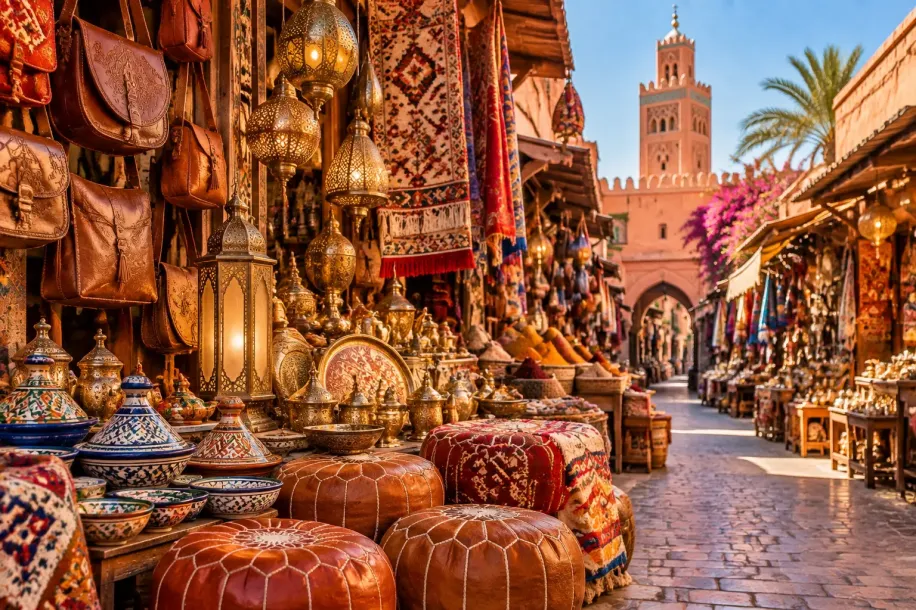
My cousins from Casablanca visit every spring, and they still get quoted tourist prices in Souk Semmarine. It happens because they speak city Darija, walk fast, and look lost. The price here is not a sticker. It is a conversation, and the first number is only the opening line.
I grew up a few alleys from Rahba Kedima, the spice square. I learned Marrakech souk bargaining by carrying bags for my mother on Saturday mornings. This guide is what I tell every friend who visits: what to say, what to pay, and when to walk away.
Well the quick answer is to let the vendor name the first price. Counter at 30 to 40 percent of it. Expect to settle around 50 to 60 percent. Pay cash in dirhams, stay friendly, and only bargain for things you actually want.
What Percentage Should You Negotiate in Marrakech?
Counter at 30 to 40 percent of the opening price, and aim to settle between 50 and 60 percent. That is the honest answer to what percentage you should negotiate in Marrakech. It holds most souvenirs in the main tourist lanes.
The item and the location change the math, though. Use this as a rough guide:
| Where you are shopping | Typical first markup | Your first counter | Realistic settle |
| Souk Semmarine and lanes near Jemaa el-Fnaa | 2 to 4 times the fair price | 30% of asking | 40 to 55% |
| Specialist souks (Haddadine, Smata, Cherratine) | 1.5 to 2.5 times | 40% of asking | 55 to 70% |
| Rug shops with a tea salon | 3 times or more | 25 to 30% of asking | 35 to 50% |
| Small food items, olives, bread | Little or none | Don’t bargain | Posted or quoted price |
These percentages reflect local experience and a strong consensus across traveller forums. They are not rules. A vendor with a genuinely handmade piece may only move 20 percent, and that can still be fair.
How Much Should You Pay in Marrakech Souks? (2026 Price Guide)
Most souvenirs settle between 30 and 800 dirhams (MAD) after bargaining. Rugs are the big exception. The table below answers how much you should pay in Marrakech souks for the items visitors buy most.
All figures are Marrakech souk prices after a friendly negotiation, not opening quotes. Prices vary by vendor, season, quality, and your bargaining.
| Item | Fair settled price (MAD) | What drives the price |
| Leather babouches | 80 to 200 | Leather grade, hand-stitched sole, embroidery |
| Small leather bag | 200 to 400 | Real leather vs. synthetic, stitching |
| Large leather bag or travel bag | 400 to 800 | Size, lining, hardware quality |
| Leather pouf cover (unstuffed) | 250 to 500 | Size and embroidery detail |
| Small tin or metal lantern | 30 to 100 | Size and cut-work detail |
| Brass lantern, medium | 150 to 500 | Brass weight, hand-hammered vs. stamped |
| Brass tea tray | 200 to 500 | Diameter and engraving |
| Ceramic tagine (serving or decorative) | 30 to 200 | Size, glaze, cooking-safe or decorative |
| Scarf (cotton or viscose) | 30 to 80 | Fabric; real wool and silk cost more |
| Cosmetic argan oil, 100 ml | 120 to 200 | Purity, cooperative label, cold-pressed |
| Ras el hanout, 100 g | 30 to 60 | Blend quality and freshness |
| Saffron, per gram | 30 to 50 | Long, deep red threads only |
| Small kilim or flatweave rug | 800 to 3,000 | Hand-knotted vs. machine, age, wool |
| Large Berber rug | 3,000 to 15,000+ | Size, knot density, origin, age |
For rough conversions, one euro has recently bought about 10 to 11 dirhams. One US dollar buys about 9 to 10. Check the current rate on the Bank Al-Maghrib website before you travel.
Planning to buy a carpet? Read our guide to carpets and rugs in Marrakech first. For oil, see our argan oil shopping page.
Say It in Darija: The Phrases That Actually Move the Price
A few words of Darija lower prices faster than any clever tactic. Vendors respect effort, and it signals you are not a first-hour tourist. These are the phrases I use every week.
| Darija (how it sounds) | Meaning | When to use it |
| Salam alaykoum | Peace be upon you (hello) | Always, before anything else |
| Bshhal hada? | How much is this? | To get the first price |
| Ghali bzzaf | Too expensive | After the first quote, with a smile |
| Nqes shwiya | Lower it a little | When you are close |
| Akhir taman? | Last price? | Near the end of the deal |
| La, shukran | No, thank you | To decline guides or pushy offers |
| Safi, mzyan | Okay, good | To accept the deal |
| Baraka Allahu fik | God bless you (thank you) | After paying |
One local detail most guides miss: older Marrakchis still count in ryal. One dirham equals 20 ryal. If an elderly vendor says “miyat ryal,” he means 5 dirhams, not 100. Ask “b dirham?” (in dirhams?) if you are unsure.
How Do Tourists Bargain in Marrakech Without It Getting Awkward?
Tourists bargain best by staying relaxed, letting the vendor speak first, and treating it as a friendly game. Here is how to bargain in Marrakech step by step. It is also the honest answer to how do tourists bargain in Marrakech without leaving upset.
- Browse before you ask. Walk a lane or two and see the same item in several shops. Lanterns, babouches, and bowls repeat everywhere.
- Greet first. A simple salam alaykoum changes the tone of the whole exchange.
- Let the vendor name a price. Never offer first. If he asks “What’s your price?”, reply “Bshhal?” again with a smile.
- Counter low, but not insultingly. Offer 30 to 40 percent of the opening number. Name a real figure, not “cheaper.”
- Point out honest details. Loose stitching or a scratch on brass is a fair reason for a lower price.
- Move up slowly. Raise your offer in small steps, maybe 10 to 20 dirhams on small items.
- Bundle items. Buying three pairs of babouches earns a better per-pair price than buying one.
- Walk away politely. Say “shukran” and step out. If your price was fair, he will often call you back.
- Close cleanly. Once you agree, pay the exact amount. Backing out after agreeing is considered rude.
Timing helps too. Many vendors believe the first sale of the day, the stiftah, brings luck. Shopping between 9 and 11 a.m. can earn a softer first sale.
These Marrakech haggling tips work anywhere in the country. Bargaining in Morocco follows the same rhythm from Fes to Essaouira, though Marrakech opening prices run higher.
Can You Bargain Everywhere in Marrakech?
No. Bargaining belongs to the souks, workshops, and independent shops, not to every purchase. Here is the short answer to can you bargain everywhere in Marrakech:
| Place or purchase | Bargain? | Notes |
| Medina souks and artisan workshops | Yes, expected | This is where Marrakech market bargaining lives |
| Rug and antique shops | Yes, hard | Big markups, long negotiations, often over tea |
| Ensemble Artisanal (Avenue Mohammed V, near Koutoubia) | No, fixed prices | Great for checking fair prices before the souks |
| Supermarkets (Carrefour, Marjane) | No | Fixed labelled prices |
| Pharmacies | No | Regulated prices |
| Café and restaurant menus | No | Pay the menu price |
| Jemaa el-Fnaa food stalls | No, but check first | Confirm the price of each dish before you eat |
| Petits taxis | Insist on the meter | Agree a fare before you get in if the driver refuses |
| Women’s argan cooperatives | Usually fixed | Some allow a small discount on larger orders |
I send every first-time visitor to the Ensemble Artisanal before the souks. Their fixed prices are higher than a good souk deal. Still, they give you a reliable ceiling for every negotiation afterward.
Want more places to shop at set prices? Browse our Marrakech shopping directory. For older pieces, see our antiques guide.
First Time Shopping in Marrakech Souks? Learn the Map Before the Prices
Go to the specialist souk for each item, not the first stall off Jemaa el-Fnaa. That one habit matters most for your first time shopping in Marrakech souks. Every trade has its own quarter, and prices drop as you go deeper.
- Souk Semmarine: the main covered spine running north from Jemaa el-Fnaa. Use it for orientation; its markups are the highest.
- Rahba Kedima (Place des Épices): spices, herbs, dried roses, and baskets in an open square.
- Souk Zrabia: the carpet quarter beside Rahba Kedima, once the old Berber auction square.
- Souk Haddadine: blacksmiths and brass workers hammering lanterns right in front of you.
- Souk Smata: babouches in every colour and leather grade.
- Souk Cherratine: leather bags, belts, and poufs.
Our guide to the most beautiful souks of Marrakech covers each quarter in more depth. If you are buying spices, read where to find the best spices in Marrakech’s markets.
A word on “helpful” strangers. Someone may tell you the tanneries close today, or a Berber market is “only open today.” These are well-known tricks to steer you into shops that pay a commission. Say “la, shukran” and keep walking. If you want a guide, book a licensed one through your riad.
Friday rhythm. Friday is the day of communal prayer. Many shops open late, often after the midday prayer, then trade normally in the afternoon.
For the bigger picture of the old city, see our complete medina of Marrakech guide.
Common Bargaining Mistakes in Marrakech (and What to Do Instead)
The most expensive mistake is showing you love something before asking the price. Here are the common bargaining mistakes in Marrakech I see visitors make every week:
- Naming the first price. You will almost always offer more than the vendor expected. Let him start.
- Bargaining without intent to buy. Negotiating to a price and then leaving is disrespectful. Only haggle when you want the item.
- Shopping with a hustler guide. A “free” guide usually earns a commission, which lands on your bill.
- Flashing big notes. Paying 150 MAD with a 200 note is fine. Opening a thick wallet is not.
- Converting prices in your head too fast. “It’s only 20 euros” feels cheap until you realise the fair price was 10.
- Getting angry. Heat kills deals. A laugh and a polite exit work far better.
- Buying rugs on day one. Rugs are the biggest markup in the medina. Compare at least three shops first.
- Assuming tea means you must buy it. Accepting mint tea is hospitality, not a contract. Still, be honest early if you are just looking.
- Paying in euros. Vendors may accept them, but at a poor rate. Dirhams give you better prices.
Cash, Cards, and Carrying Your Shopping
Bring cash in dirhams. Most souk stalls do not take cards. Some larger rug, jewellery, and antique shops accept Visa or Mastercard, and travellers often report a surcharge.
The dirham is a closed currency, so you generally cannot buy it before arriving. ATMs are easy to find around Jemaa el-Fnaa, Gueliz, and the main medina gates. Carry a mix of 20, 50, and 100 dirham notes and some coins.
Final Word from a Local
Bargaining is not a fight. It is how neighbours in the medina have traded for centuries. Smile, learn three Darija phrases, and know your price range before the tea arrives.
Follow this Marrakech shopping guide and you will pay close to what locals pay. You will also leave with better stories than the traveller who paid the first price. Bslama, and happy shopping.
Frequently Asked Questions
How do you get the best price in Marrakech?
Knowing how to get the best price in Marrakech starts with comparing three shops before you buy. Shop in the morning and let the vendor quote first. Bundling several items together also earns a noticeably better per-item price.
How can you avoid overpaying in Marrakech souks?
The simplest way to learn how to avoid overpaying in Marrakech souks is to check fixed prices at the Ensemble Artisanal first. Then decline unofficial guides, pay in dirhams, and stay ready to walk away politely.
What are the best Marrakech souk shopping tips for a short trip?
The best Marrakech souk shopping tips for a short trip are simple. Buy each item in its specialist souk, carry small notes, and avoid rushing rug purchases. Save the biggest buys for your last day, once you know real prices.
Is it rude not to bargain in Marrakech?
No, it is not rude to pay the asking price. Vendors will simply be happy. However, bargaining is expected and friendly, so a polite counter-offer never offends anyone.
Do vendors in Marrakech accept euros or US dollars?
Some souvenir shops accept euros, and a few take dollars, but usually at a poor exchange rate. Paying in dirhams almost always gets you a better price. Withdraw dirhams from a local ATM on arrival.
Are these Moroccan souk shopping tips useful outside Marrakech?
Yes. These Moroccan souk shopping tips apply in Fes, Essaouira, and Chefchaouen too. Opening prices in Marrakech are usually higher, so expect slightly easier negotiations in smaller cities.
Is accepting mint tea in a shop an obligation to buy?
No. Mint tea is a gesture of hospitality, especially in rug shops. It is polite to look seriously at what the vendor shows you, but you are free to leave without buying.


