



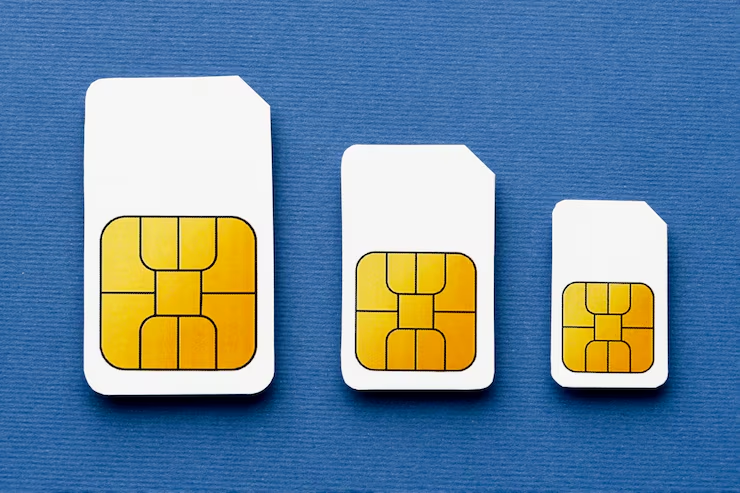
Getting online fast matters in Marrakech. You will use your phone for Google Maps in the medina, WhatsApp with your riad host, ride-hailing apps, and translation tools at the souks. This guide covers everything you need to get connected, from local SIM cards to eSIM options, prices, and which network to pick for your trip.
Morocco’s Three Mobile Networks
Morocco has three main mobile operators. All three sell prepaid SIM cards to tourists and offer 4G, with 5G rolling out in major cities.
Maroc Telecom (also called IAM or Itissalat al-Maghrib)
Maroc Telecom is the oldest and largest operator in the country. It has the widest coverage in rural areas, the Atlas Mountains, and the Sahara Desert. If your trip includes a desert tour to Merzouga or Zagora, or a multi-day drive through the mountains, this is generally the safest network choice.
Orange Morocco (formerly Meditel)
Orange is known for strong urban coverage and competitive tourist bundles. In cities like Marrakech, Casablanca, and Rabat, Orange often delivers the fastest 5G speeds. Coverage thins out faster than Maroc Telecom once you leave main highways and tourist towns.
inwi
inwi is Morocco’s third operator and usually offers the most data per dirham. It is popular with younger Moroccans and digital nomads because of its large prepaid bundles and unlimited data plans. Coverage is solid in cities and along major roads but can be weaker in remote rural pockets compared to Maroc Telecom.
Quick Comparison
| Network | Best For | StrengthStrength | Weakness |
| Maroc Telecom (IAM) | Desert trips, Atlas Mountains, rural routes | Widest national coverage | Slightly pricier data in some bundles |
| Orange Morocco | City-only trips, fast urban data | Strong 5G in Marrakech, Casablanca, Rabat | Weaker signal outside main cities |
| INWI | Budget travelers, digital nomads | Best data per dirham, unlimited plans | Weaker in remote and rural areas |
For most visitors staying inside Marrakech and doing day trips to the Atlas Mountains or Ourika Valley, any of the three works well. If your itinerary includes a Sahara desert tour, lean toward Maroc Telecom or inwi.
Where to Buy a SIM Card in Marrakech
Marrakech Menara Airport (RAK)
All three carriers run kiosks in the arrivals hall at Marrakech Menara Airport, usually open from early morning until midnight. This is the most convenient option, since you can walk out of the airport already connected. The tradeoff is price. Airport SIM cards in Morocco often cost more than the same package bought in the city, sometimes 20 to 40 percent higher, though pricing has become more standardized at some airports in recent years. If convenience matters more than saving a few dollars, buying at the airport is a perfectly reasonable choice.
City Stores in Gueliz and the Medina
The Gueliz district in Marrakech has official Maroc Telecom, Orange, and inwi stores within walking distance of each other, making it easy to compare plans in person. Staff at these stores usually speak French and often English, and they will insert the SIM, activate it, and set up the data settings (APN) for you. Buying in the city almost always gets you a better price than the airport.
Convenience Stores, Supermarkets and Street Vendors
Smaller mini markets, electronics shops, and supermarkets such as Carrefour or Aswak Assalam also sell prepaid SIM cards, usually for a small card fee plus the standard data rate. Street vendors near tourist areas sometimes sell SIM cards too, but prices are not fixed and can vary a lot from one seller to the next. For a reliable price and proper setup help, an official carrier store or airport kiosk is the safer choice over a street vendor.
What You Need to Buy a SIM Card
- Your passport. Moroccan law requires ID registration for every SIM card sold, including prepaid tourist SIMs. Bring the physical passport, not just a photo of it.
- An unlocked phone. Your device needs to accept a foreign SIM. Check with your home carrier before you fly if you are not sure your phone is unlocked.
- Cash or card. Airport kiosks generally accept Visa, Mastercard, dirhams (MAD), euros, and US dollars. City stores mostly prefer dirhams.
Registration itself is free. You only pay for the SIM card and the data package you choose.
Prices: What a SIM Card Costs in Marrakech
Prices change over time and vary by promotion, but as a general guide for 2026:
- Basic SIM card activation: roughly 20 to 50 MAD (about $2 to $5 USD)
- Small tourist data packages (around 5 to 12 GB): roughly 100 to 165 MAD (about $10 to $16 USD)
- Larger data packages (around 30 to 50 GB, valid 30 days): roughly 165 to 200 MAD (about $16 to $20 USD)
- inwi unlimited data plans: priced higher upfront but offer the best value for long stays or heavy data users, usually with a fair use policy around 100 GB before speeds slow down
Most tourist SIM packages include some calling minutes alongside data, since Moroccan carriers bundle both into a single “Pass.” If you only need data, ask the clerk specifically for a data-only pass, since standard top-ups often include a mix of minutes and smaller data allowances.
Top-ups and recharges cost roughly 10 MAD per GB on Maroc Telecom and inwi, and can be done at any small shop or kiosk displaying the carrier’s logo.
eSIM Options for Marrakech
If your phone supports eSIM (most iPhones from the XS onward and recent Android models), you can activate a Moroccan data plan before you even board your flight. This skips the airport queue and the passport registration step entirely, since most international eSIM providers do not require ID.
How it works: You buy a plan online, receive a QR code by email, and scan it into your phone’s settings. When you land in Marrakech and turn on data roaming for that eSIM profile, it connects automatically to a local network.
Popular international eSIM providers for Morocco include Airalo, Holafly, Nomad, Saily, and a handful of smaller competitors. These typically route through Orange Morocco, Maroc Telecom, or inwi behind the scenes, so coverage quality is similar to buying directly from the carrier. Pricing generally works like this:
- Small data plans (1 to 5 GB): roughly $5 to $15 USD
- Mid-size plans (10 to 20 GB): roughly $20 to $35 USD
- Unlimited data plans: roughly $27 to $40 USD for 7 to 10 days, though “unlimited” plans usually apply a daily high-speed data cap (commonly around 3 GB per day) before slowing your speed
eSIM pros: instant setup before you fly, no passport needed, keeps your home number active for calls and texts on a dual-SIM phone, easy to top up through an app.
eSIM cons: generally more expensive per gigabyte than a local physical SIM, data-only in most cases (no local phone number for calls), and hotspot or tethering allowances are sometimes limited depending on the provider.
A common strategy: buy a small eSIM plan for your first day or two, covering the airport transfer and hotel check-in, then buy a cheaper physical SIM in the city once you have time to visit a store. This gives you instant connectivity on arrival plus the better value of a local SIM for the rest of the trip.
SIM Card vs eSIM: Which Should You Choose?
- Choose a physical SIM if: you want the lowest cost per gigabyte, you are staying in Morocco for more than two weeks, or you want a local phone number.
- Choose an eSIM if: you land late at night, you want data the second you step off the plane, you would rather avoid a store visit, or your phone is dual-SIM and you want to keep your home number active for calls.
- Combine both if: you want the best of both worlds, an eSIM for day one and a local SIM for the rest of the trip.
Setting Up Your SIM or eSIM
Physical SIM
- Bring your passport to the counter.
- Ask the staff to insert the SIM, activate it, and set up the APN (the network settings that allow data to work).
- Ask them to run a quick speed test before you leave the counter, so you know it is working.
- Photograph the SIM packaging (it usually has an ICCID number) and keep your receipt in case you need support later.
eSIM
- On iPhone: go to Settings, then Cellular, then Add eSIM, and scan the QR code.
- On Android: go to Settings, then Network & Internet, then SIMs, and add the eSIM using the QR code.
- Set the new Moroccan line as your data line, while keeping your home line active for calls and messages if needed.
- Turn on Data Roaming for the new line once you land.
- If data does not connect, check that the correct APN is entered under your cellular data network settings.
Network Coverage: What to Expect
Morocco has good 4G coverage across cities, tourist areas, and main highways. In Marrakech itself, including the medina, Gueliz, and the Palmeraie, all three carriers perform well, though thick medina walls and narrow alleys can occasionally weaken signal strength in specific spots.
Coverage gets patchier once you head into the High Atlas Mountains or deep into the Sahara Desert. Maroc Telecom generally holds a signal longest in these remote areas, though every network loses connection on some mountain passes and desert tracks. If you are joining an organized desert tour, do not rely on constant connectivity once you are off the main roads.
Using WhatsApp and Calling Apps in Morocco
Morocco does not block VoIP services on mobile data. WhatsApp, FaceTime, Telegram, and Google Meet all work normally over 4G and 5G on every Moroccan carrier. This matters because many riads, guides, and taxi drivers communicate primarily through WhatsApp rather than SMS or phone calls, so a working data connection often functions as your main communication channel even without a local phone number.
Practical Tips
- SIM registration takes just a few minutes at any official store or airport kiosk.
- Airport prices are not always dramatically higher than city stores anymore, but city stores still tend to offer better value and more plan choices.
- A SIM card usually stays valid until its data plan expires, and can often be reactivated with a top-up if you return to Morocco within a few months.
- Download offline maps for the medina, the Atlas Mountains, and any desert route before you rely on live data, since GPS can struggle in narrow medina streets regardless of signal strength.
- If you plan to use your phone as a hotspot for a laptop, confirm hotspot or tethering is included before buying, since some entry-level tourist packs and some eSIM unlimited plans limit or throttle tethering speeds.
- Keep your SIM ejector tool or a paperclip handy, and keep the tiny SIM tray safe if you switch between your home SIM and a Moroccan SIM during the trip.
Frequently Asked Questions
Which network is best for tourists in Marrakech: Maroc Telecom, Orange, or inwi?
For city-only trips in Marrakech, all three perform well and pricing is similar. If your trip includes the Atlas Mountains or a Sahara desert tour, Maroc Telecom generally offers the most reliable coverage in remote areas.
How much does a SIM card cost in Marrakech?
Basic activation runs about 20 to 50 MAD. Tourist data packages typically cost 100 to 200 MAD depending on the amount of data, which is roughly $10 to $20 USD.
Do I need my passport to buy a SIM card in Morocco?
Yes. Moroccan law requires ID registration for every SIM card, so bring your physical passport to the store or kiosk.
Is it cheaper to buy a SIM card at the airport or in the city?
City stores in areas like Gueliz are generally cheaper than airport kiosks, though the price gap has narrowed at some airports. If you want data the moment you land, the airport is still the most convenient option.
Should I get an eSIM or a physical SIM card for Marrakech?
An eSIM is more convenient since you can activate it before you fly and skip the passport and store visit. A physical SIM is usually cheaper per gigabyte, especially for longer stays. Many travelers use a small eSIM for their first day and switch to a local SIM in the city afterward.
Will my phone work in Morocco?
Yes, as long as it is unlocked and supports the local network bands. Morocco primarily uses 4G LTE Band 3 and Band 7, which most modern smartphones support.
Does WhatsApp work in Morocco?
Yes. WhatsApp, FaceTime, and similar apps work normally over any Moroccan mobile network, and WhatsApp is commonly used by riads, guides, and taxi drivers for communication.
Can I use my SIM card outside Marrakech, like in Fes or the Sahara?
Yes, a Moroccan SIM card works nationwide. Coverage quality varies by carrier once you leave major cities, with Maroc Telecom generally offering the strongest signal in rural and desert areas.


