



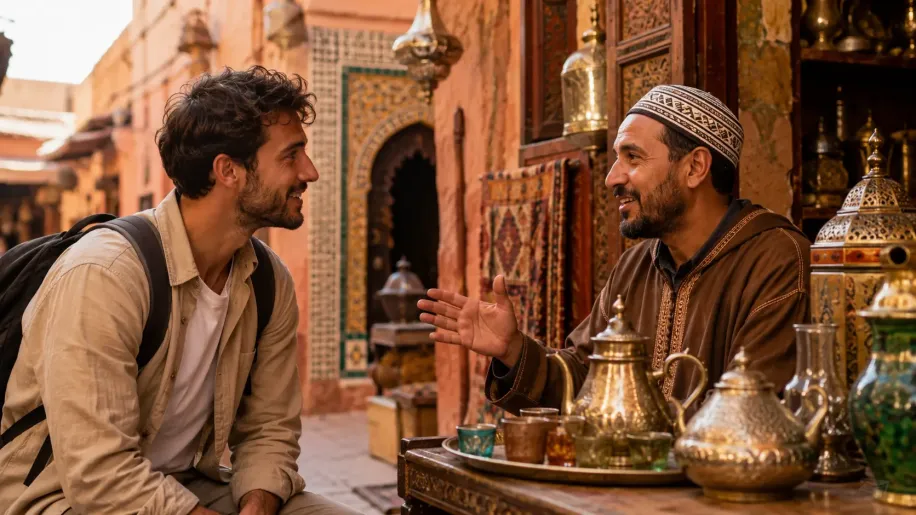
Learning a handful of Moroccan Arabic phrases before your trip changes how locals treat you in Marrakech. Even a simple greeting in the local tongue softens negotiations, opens doors, and earns you genuine smiles instead of tourist pricing.
I grew up switching between French, Arabic, and Darija depending on who I was speaking to. This guide breaks down the exact Darija phrases for tourists that get used the most, from greetings to bargaining to ordering food.
What Language Is Spoken in Marrakech?
Before diving into vocabulary, it helps to understand what language is spoken in Marrakech. Moroccans speak Darija, a distinct dialect of Arabic mixed with Berber, French, and Spanish influences. It sounds quite different from Modern Standard Arabic taught in textbooks.
French is also widely spoken, especially in shops and hotels, thanks to Morocco’s colonial history. Berber languages remain common in mountain regions near Marrakech. Knowing even a few Moroccan Darija phrases shows respect and curiosity that locals genuinely appreciate.
Do Tourists Need to Speak Arabic in Marrakech?
A common question travelers ask is whether do tourists need to speak Arabic in Marrakech to get by comfortably. The honest answer is no, since English and French cover most situations in hotels, restaurants, and major shops. However, a few basic Moroccan Arabic words go a long way in the medina and local markets.
Vendors and taxi drivers notice immediately when tourists make an effort. It often leads to friendlier service and occasionally better prices during negotiations.
Essential Greetings and Everyday Phrases
These Arabic phrases for Marrakech cover the basics you will use constantly throughout your trip:
- Salam (سلام) — Hello
- Labas? (لاباس) — How are you?
- Labas, alhamdulillah — I’m fine, thank God
- Smahli (سمحلي) — Excuse me / sorry
- Shukran (شكرا) — Thank you
- Afak (عفاك) — Please
- Bslama (بسلامة) — Goodbye
These useful Moroccan Arabic phrases work in almost any setting, from hotel lobbies to street vendors, and take only a few minutes to memorize.
Moroccan Arabic Phrases for Shopping in Marrakech
Shopping in the souks is where Darija becomes genuinely useful. These Moroccan Arabic phrases for shopping in Marrakech help you navigate stalls with more confidence:
- Bshhal hada? (بشحال هادا) — How much is this?
- Ghali bezaf (غالي بزاف) — Too expensive
- Nqes shwiya (نقص شوية) — Lower it a little
- Wakha (واخا) — Okay / agreed
- Ana ghi kanshouf — I’m just looking
Practicing these Marrakech Arabic phrases before you enter a shop helps you feel less rushed once bargaining actually starts.
How to Bargain in Moroccan Arabic
Knowing how to bargain in Moroccan Arabic transforms the shopping experience in Marrakech’s markets. Start by asking the price, react with mild surprise, then offer roughly half using the phrase above. Vendors expect this exchange and often enjoy it as part of the process.
Staying friendly and smiling throughout the negotiation matters more than the words themselves. Darija bargaining is as much about tone and patience as vocabulary.
Moroccan Arabic Phrases for Ordering Food
Food markets and cafes are another place where Moroccan Arabic phrases for ordering food come in handy. A few essentials:
- Bghit… (بغيت) — I would like…
- Shwiya (شوية) — A little / small amount
- Bnina (بنينة) — Delicious
- L’addition, afak — The bill, please
- Ma bghitsh harr — I don’t want it spicy
These small phrases make ordering feel personal rather than transactional, especially at family-run stalls around Jemaa el-Fnaa.
Moroccan Arabic Phrases for Taxis
Getting around the city is easier once you know a few Moroccan Arabic phrases for taxis. Try these when hopping into a petit taxi:
- Fin…? (فين) — Where is…?
- Sir nishan (سير نيشان) — Go straight
- Waqf hna, afak — Stop here, please
- Bshhal ghadi ykoun? — How much will it be?
Always confirm the price or insist on the meter before the ride begins, since this avoids most tourist overcharging.
How to Say No Thank You in Moroccan Arabic
Persistent vendors are common in busy markets, so knowing how to say no thank you in Moroccan Arabic saves you from awkward, drawn-out exchanges. The simplest version is La shukran (لا شكرا), meaning “no, thank you.” Saying it firmly but politely usually ends the conversation quickly.
If someone continues pushing after that, repeating the phrase while walking away works better than engaging further.
Basic Darija Phrases for Travelling in Morocco
Beyond Marrakech itself, these basic Darija phrases for travelling in Morocco apply almost everywhere in the country:
- Fin kayn…? — Where is…?
- Bghit nmshi l… — I want to go to…
- Kayn atay? — Is there tea?
- Sahha — Cheers / bless you
Whether you are heading to Fes, Essaouira, or the desert, these Moroccan phrases for travel remain consistent across regions.
Useful Arabic Words to Know Before Visiting Marrakech
If you want a shorter list to memorize quickly, these useful Arabic words to know before visiting Marrakech cover the highest-frequency situations:
- Naam — Yes
- La — No
- Afak — Please
- Shukran — Thank you
- Bshhal — How much
- Fin — Where
- Zwina — Beautiful / nice
Print or screenshot this short list before you land, since it covers nearly every basic interaction tourists face.
Final Thoughts
Mastering even a small set of essential Moroccan Arabic phrases for Marrakech tourists changes the tone of your entire trip. Locals respond warmly to effort, and small phrases like greetings, thank yous, and bargaining lines open conversations that go far beyond simple transactions.
Darija for travellers does not need to be perfect. A few mispronounced words, said with a smile, carry more weight than most people expect.
FAQs
Do tourists need to speak Arabic in Marrakech?
No, English and French are widely understood, but a few Darija phrases help with bargaining and everyday interactions in local markets.
What language is spoken in Marrakech?
Darija, a Moroccan dialect of Arabic mixed with Berber and French influences, alongside French and, in tourist areas, English.
How to bargain in Moroccan Arabic?
Ask the price with “Bshhal hada?”, react with mild surprise, then counter with roughly half the quoted price and negotiate from there.
How to say no thank you in Moroccan Arabic?
Say “La shukran” firmly but politely. Repeating it while walking away usually ends persistent sales pitches quickly.
What are some useful Moroccan Arabic phrases for shopping?
Key phrases include “Bshhal hada?” for price, “Ghali bezaf” for too expensive, and “Nqes shwiya” to ask for a lower price.
What are basic Moroccan Arabic phrases for ordering food?
Try “Bghit…” to say what you want, “Bnina” for delicious, and “L’addition, afak” to ask for the bill.


