



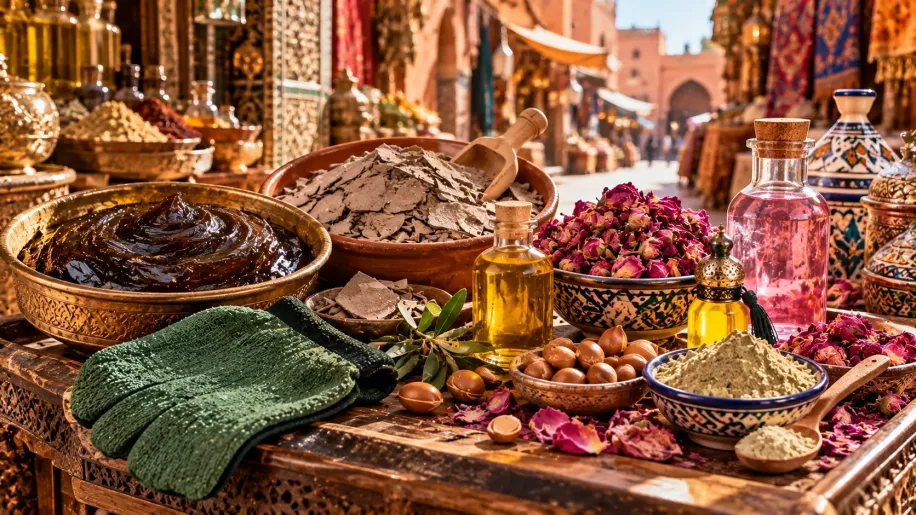
Step into the herbalist stalls around Rahba Kedima, the old spice square, and the shelves look like a chemistry lab run by a grandmother. There are tubs of dark, glossy soap, sacks of grey clay flakes, bottles of rose water and dried roses, and tiny vials of oil kept behind the counter. Every Marrakchi household knows what each one is for, and most visitors leave with at least one of them.
Moroccan beauty products are some of the best souvenirs you can buy in the city because they are useful, light to pack and cheap when bought well. They are also easy to overpay for or buy diluted. This guide explains what each product does, how to use it at home, what to pay in 2026 and how to tell the real thing from a tourist copy.
The Best Moroccan Beauty Products to Buy
If you only have room for a few items, these are the best Moroccan beauty products to buy.
| Product | What It Is | Typical Price |
| Black soap (savon beldi) | Olive-based soft soap for the hammam | About 20 to 80 dirhams, depending on size |
| Ghassoul clay | Mineral clay from the Middle Atlas | About 15 to 30 dirhams a small bag, 60 to 100 per kilo |
| Kessa glove | Coarse exfoliating mitt | Around 20 dirhams or less |
| Cosmetic argan oil | Cold-pressed oil from unroasted kernels | About 100 to 140 dirhams per 100 ml |
| Rose water | Distilled from Damask roses | About 25 to 60 dirhams a bottle |
| Prickly pear seed oil | Rare, concentrated face oil | About 250 to 400 dirhams per 30 ml |
Prices may vary depending on season, provider, availability and how well you bargain.
Moroccan Black Soap
Moroccan black soap, known locally as savon beldi, is not a bar at all. It is a soft, dark paste made from olive oil and crushed olives, sometimes blended with eucalyptus, rosemary or ghassoul. You will see the jars of Moroccan black soap Marrakech herbalists scoop by weight in almost every souk, and it is the first step of every traditional hammam. On its own it cleans gently and softens the skin, ready for scrubbing.
How to Use Moroccan Black Soap
If you are wondering how to use Moroccan black soap at home, follow the same order a hammam attendant would.
- Steam your skin first with a long, hot shower or bath for 10 minutes or so.
- Spread a thin layer of soap over damp skin and leave it for about five minutes.
- Rinse, then scrub in long strokes with a kessa glove until the dead skin rolls away.
- Rinse again and finish with a few drops of argan oil while your skin is still damp.
Once a week is plenty. Patch-test first if your skin is sensitive, and keep it away from your eyes.
Where to Find the Best Moroccan Black Soap in Marrakech
The best Moroccan black soap in Marrakech usually comes from herbalists around Rahba Kedima and from cooperative or fixed-price shops such as the Ensemble Artisanal on Avenue Mohammed V. Good beldi soap smells earthy, of olives, rather than heavily perfumed. Ask to see inside the tub before it is weighed out.
Ghassoul Clay
Ghassoul, also spelled rhassoul, is a mineral clay mined in the Moulouya Valley of the Middle Atlas, about 200 kilometers from Fes. Its name comes from the Arabic for washing, and its use is believed to date back centuries, mainly as part of the hammam ritual. Like most Moroccan natural beauty products, it is sold loose, as grey-brown flakes or fine powder, sometimes already mixed with herbs or rose petals.
How to Use Ghassoul Clay
Learning how to use Ghassoul clay takes about a minute. Mix a spoonful of powder with water or rose water until it reaches the texture of thick yogurt. Smooth it over your face or body, leave it for five to ten minutes and rinse before it dries completely. For hair, apply it to damp hair from the roots down, leave for a few minutes and rinse well. Like black soap, it works best once a week.
Argan Oil, Rose Water and Other Moroccan Skincare Products
Argan is the most famous of all Moroccan skincare products, and the forest it comes from in southwest Morocco is a UNESCO biosphere reserve. The key to finding the best argan oil to buy in Marrakech is knowing the two types. A 2026 argan oil guide explains that cosmetic oil is cold-pressed from unroasted kernels, so it is light gold with almost no smell, while culinary oil is pressed from roasted kernels and smells of toasted nuts. Expect to pay around 100 to 140 dirhams per 100 ml for cosmetic oil. The full breakdown is in the guide to where to buy argan oil in Marrakech, and there is a separate list of the best argan oil products if you want ready-made creams and soaps.
Rose water comes from Damask roses grown around Kelaat M’Gouna in the Dades Valley, harvested from late April into May. It works as a gentle toner and to mix with ghassoul. Prickly pear seed oil is the luxury pick, priced high because it takes a huge volume of seeds to press a small bottle. A kessa glove costs very little and lasts for years if you rinse and dry it after each use.
Traditional Moroccan Hammam Products to Buy
If you want to recreate the ritual at home, these are the traditional Moroccan hammam products to buy together as a set.
- Black soap to soften the skin
- A kessa glove to exfoliate
- Ghassoul clay for a body and hair mask
- Rose water to mix with the clay
- Argan oil to finish
It helps to try a hammam in Marrakech first, so you know how the products should feel before you buy them.
How to Identify Authentic Moroccan Beauty Products
Knowing how to identify authentic Moroccan beauty products saves you from paying good money for diluted oil or perfumed paste.
- Smell before you buy. Cosmetic argan oil should smell faint and nutty, never rancid or perfumed.
- Check the clarity. Real argan oil is clear, and cloudiness can signal contamination or old stock.
- Treat very low prices as a warning. Cheap argan oil is often cut with other oils.
- Look for labels with a cooperative name, production date or certification such as ECOCERT.
- Visit a fixed-price shop first. The Ensemble Artisanal and cooperative outlets display prices for most Moroccan beauty products Marrakech shoppers look for, which gives you a benchmark before the souks.
In the souks, prices are a starting point, not a final figure. The souk bargaining guide explains how to negotiate without offending anyone.
Products to Skip or Treat With Caution
Not every traditional product is safe to use. Two deserve a clear warning.
Black Henna
Natural henna stains the skin orange to reddish brown. Anything advertised as black henna is likely to contain added dye. The US FDA warns that black henna often contains PPD, a hair dye ingredient that can cause serious skin reactions. If someone offers a henna design in Jemaa el-Fnaa, ask for natural henna only.
Kohl Eyeliner
Traditional kohl powder is sold in many herbalist shops, but the FDA’s kohl warning notes that some products contain high levels of lead, which is especially dangerous for children. It is illegal to sell in the United States. Buy a decorative kohl pot if you like the look, but skip the powder.
Shopping Tips for Moroccan Beauty Products for Tourists
A few practical points make buying Moroccan beauty products for tourists much easier.
- Pack liquids and pastes over 100 ml, including black soap, in your checked bag.
- Double-bag soap and oil, since heat can make jars leak.
- Buy smaller sizes of several products rather than one large jar, which helps with weight limits.
- For branded Moroccan skincare with clear labels, try a pharmacy in Marrakech.
- If you love scents too, pair your haul with the perfume and fragrance guide.
Moroccan beauty shopping is also easier in the morning, when shops are calmer and sellers have more time to explain their products.
Frequently Asked Questions About Moroccan Beauty Products
What Moroccan beauty products should I buy?
Start with black soap, a kessa glove, ghassoul clay, rose water and a bottle of cosmetic argan oil. Together they cover a full hammam ritual and cost less than one spa treatment.
Is Moroccan black soap the same as African black soap?
No. African black soap from West Africa is usually made with plant ash and shea butter, while Moroccan black soap is an olive-based paste.
How long does black soap last?
Used once a week, a small jar lasts for months. Keep the lid tight so it does not dry out.
Can you use argan oil on your hair?
Yes. A few drops on the ends smooth frizz. The guide to argan oil hair products covers more options.
Can you use ghassoul on your face?
Yes, as a weekly mask. Rinse it off before it dries completely, and patch-test first if your skin is sensitive.
Bringing Morocco Home
The best Moroccan beauty products are simple, inexpensive and rooted in centuries of hammam tradition. Buy black soap, ghassoul and a kessa glove for a home ritual, invest in a smaller bottle of genuine cosmetic argan oil, and skip anything sold as black henna or kohl powder. Compare prices at a fixed-price shop first, and you will come home with traditional Moroccan beauty products that you will actually use.
Planning more of your shopping? Browse the Top10Marrakech shopping directory for trusted stores across the city.


