



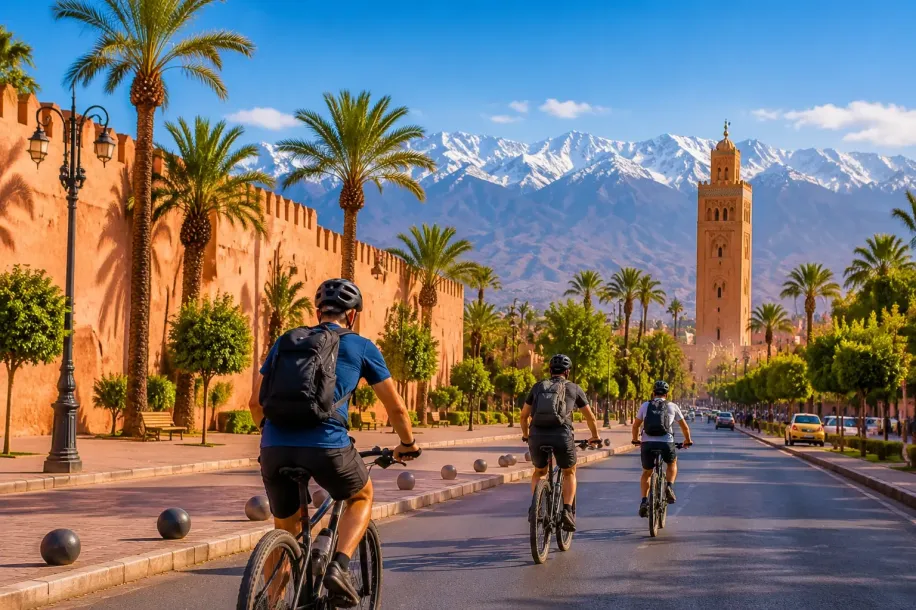
At six in the morning the road out through Bab Doukkala belongs to bread vans and cyclists. Two hours later the same stretch is a wall of scooters, and the difference between a good ride and a miserable one is entirely that gap in the clock.
Locals have known this forever. Visitors usually learn it the hard way, somewhere around 11am on Avenue Mohammed V with the sun on the back of their neck.
This guide covers what riding here is actually like, the routes worth your legs, honest pricing, and the safety rules that matter. Written from the saddle, not from a brochure.
Is Marrakech Good for Cycling?
Yes, but only in three of its four zones. Anyone asking is Marrakech good for cycling deserves a straight answer rather than a tourism-board one, so here is the breakdown:
The medina: challenging, not dangerous
Narrow derbs, pedestrians, handcarts, donkeys, and a constant stream of mopeds. Traffic moves slowly, which is the saving grace. Experienced riders find it exhilarating. Nervous riders should walk the bike through the busiest sections, which is exactly what most guided groups do without embarrassment.
Gueliz and Hivernage: genuinely good
The new city has wide boulevards, several marked bike lanes, and predictable traffic. This is where cycling to Marrakech Morocco starts to feel easy rather than adventurous.
The Palmeraie and outskirts: excellent
Quiet lanes, minimal traffic, flat terrain, palm shade. The best riding within reach of the city.
The Atlas foothills: world class
Long steady gradients, empty tarmac, and Toubkal on the horizon.
The one honest caveat: Moroccan traffic runs on flexible informal rules rather than rigid lane discipline. Riders describe it as organised chaos. It works, but you need to read it rather than assume Western road habits will be respected.
What to See in Marrakech by Bike
A bike covers in one morning what walking spreads across two days. The classic answer to what to see in Marrakech by bike links the historic core to the new city in a loop of roughly 12 to 15 kilometres.
The natural circuit:
- The ramparts. The road hugging the old city walls is the single best introduction. Twelve kilometres of pisé wall, gates every few hundred metres, and light that turns the whole thing orange near sunset.
- Bab Agnaou and the Kasbah. The Saadian Tombs and El Badi Palace sit within a few pedals of each other.
- The Mellah. The historic Jewish quarter, quieter than the central souks and far easier to ride.
- Koutoubia and its gardens. Flat, open, and the obvious pivot point between old city and new.
- Avenue Mohammed V into Gueliz. Wide, straight, partly bike-laned. Cafés, boulevards, and a completely different Marrakech.
- Jardin Majorelle and the YSL museum. A short detour north with somewhere to lock up.
- Menara Gardens. The olive grove and pavilion sit southwest of the centre with an easy approach road.
- The Zaouia of Sidi Bel Abbès. A working pilgrimage site in the northern medina that most walking tours never reach.
Add a neighbourhood bakery stop and you have the shape of most guided city rides.
Cycling From Marrakech to Palmeraie
This is the ride to do if you only do one. Cycling from Marrakech to Palmeraie takes you from the northeastern edge of the city into a working palm oasis in about 20 minutes of pedalling.
Distance: roughly 8 to 10 kilometres from the medina to the heart of the grove, with loops of 20 to 30 kilometres once you are inside. Terrain: flat, with a mix of tarmac lanes and hard-packed piste. Time: allow three to four hours to enjoy it rather than tick it.
Route in brief. Leave the medina by Bab el Khemis or Bab Debbagh on the northeastern side. Follow the road towards the Route de Fès and pick up the Circuit de la Palmeraie. Once you are past the outer hotels, the traffic falls away almost entirely.
What you actually ride through:
- Palm groves fed by khettaras. These underground irrigation channels carry Atlas meltwater across the plain and have kept this oasis alive for centuries. Guides will point out the access shafts.
- Villas and villages side by side. Luxury compounds sit a few hundred metres from smallholder farms and mudbrick homes. The contrast is the point.
- Open desert edge. Beyond the grove the ground turns stony and the Atlas becomes the whole southern horizon.
Two practical warnings. Sand traps catch narrow tyres on the piste sections, so a hybrid or mountain bike beats a road bike here. And there is almost no shade in the open stretches despite the palms, so carry more water than feels necessary.
Best Cycling Routes in Marrakech and the Surrounding Region
The best cycling routes in Marrakech range from a flat city loop to a 2,600 metre alpine climb. Pick by fitness, not by ambition.
| Route | Distance | Elevation gain | Surface | Suits |
| Ramparts and medina loop | 12 to 15 km | Negligible | Tarmac, some cobbles | All levels |
| Palmeraie circuit | 20 to 30 km | Minimal | Tarmac and piste | Beginners upward |
| Marrakech to Lalla Takerkoust lake | around 30 km each way | Gentle | Tarmac | Improvers |
| Marrakech to the Ourika Valley mouth | around 29 km each way | 495 m to 860 m, averaging 1.25% | Tarmac | Reasonable fitness |
| Marrakech to Oukaïmeden | 70 km each way | 2,129 m | Tarmac | Strong riders only |
| Kik Plateau via Moulay Brahim | Day ride with transfer | Sustained climbing | Tarmac | Experienced |
Two notes on the harder options. The Ourika approach is deceptive because the gradient rarely feels like climbing while the altitude quietly accumulates. And the Oukaïmeden ascent proper covers about 30 kilometres at an average of 5.49% to a ski station at 2,624 metres, which is a serious day by any standard.
These upper routes form the basis of the Marrakech Atlas Etape, the annual sportive that draws riders to the region each spring.
For shorter cycling routes Marrakech riders use daily, the ramparts loop and the Palmeraie circuit cover almost everything.
Where to Rent Bikes in Marrakech
Expect 80 to 150 MAD per day for a standard bike and 400 MAD per day for an e-bike. The question of where to rent bikes in Marrakech has three real answers.
Pikala Bikes
A social enterprise based in the medina that refurbishes bikes, runs a repair workshop and café, and trains young Moroccans as cycling guides. It also operates in Agadir. Standard rental runs around 100 MAD for the first day and less for subsequent days, with bikes suited to city, souk, and Palmeraie riding. Delivery and collection to your accommodation is available for an additional charge. Renting here funds youth training, which is a rare thing to be able to say about a bike shop.
Commercial e-bike operators
everal Gueliz-based companies rent electric bikes with 60 to 70 kilometre ranges, typically around 260 MAD for four hours or 400 MAD for a full day. Worth the premium if you plan to reach the Palmeraie and back in heat.
Riads and hotels
Many properties keep a few bikes. Quality varies enormously. Check the brakes before you accept one.
A word on the public bike-share scheme. Medina Bike launched around COP22 in 2016 with roughly 320 bikes and about a dozen stations at points including the Koutoubia and Jardin Majorelle, with day passes around 50 MAD. Station coverage has always been thin and user reports on reliability are mixed. Treat it as a bonus rather than a plan.
Before you rent a bike Marrakech operators hand over, check three things: brake function, tyre pressure, and whether a lock is included. Any decent Marrakech bike rental includes a lock as standard.
Marrakech Bike Tour Price: What to Budget
Guided rides run from roughly 250 MAD for a short city tour to well over 1,000 MAD for a full Atlas day with transfers. The Marrakech bike tour price you pay depends mostly on duration and whether transport out of the city is involved.
| Tour type | Duration | Typical price per person |
| Medina and Gueliz city tour | 3 to 4 hours | 250 to 500 MAD |
| Palmeraie oasis tour | 3 to 4 hours | 300 to 600 MAD |
| Full-day city and oasis combined | 6 to 7 hours | 600 to 900 MAD |
| E-bike guided tour | 3 to 4 hours | 500 to 800 MAD |
| Atlas foothills day ride with transfer | Full day | 900 MAD upward |
| Multi-day Atlas road tour | 3 to 5 days | Quoted per itinerary |
Prices vary by operator, season, and group size, and booking platforms usually cost more than contacting an operator directly. Verify before booking.
Most tours include the bike, helmet, water, and a tea or snack stop. Confirm whether entry fees to any sites are covered, since several are not.
Best Bike Tours in Marrakech and Who Each Suits
There are four distinct formats, and the best bike tours in Marrakech for you depends entirely on which one matches your appetite.
The cultural medina ride
Slow-paced, stop-heavy, and focused on daily life rather than monuments. Typical stops include a communal neighbourhood bakery where residents bring their own dough, a hammam furnace room, and an artisan workshop. This is the format most Marrakech cycling tours with a social enterprise angle use, and it is the strongest choice for first-time visitors.
The old and new contrast ride
Medina plus Gueliz and Hivernage in one loop. Good if you want to understand how the city fits together rather than only see its oldest quarter.
The Palmeraie escape
Out of the traffic within 20 minutes, into palm groves and villages, usually with a village breakfast or tea stop. The pick for anyone who wants scenery over street life.
The Atlas day ride
A van transfers to the foothills, then real climbing on quiet tarmac. For riders with road fitness who want the mountains.
Booking a Marrakech cycling tour with guide support solves three problems at once: navigation in a city where alleys defeat GPS, cultural context you would otherwise miss entirely, and someone who knows which junctions to walk. For a first ride here, the guided option is worth it even for confident cyclists.
Groups on the better bike tours Marrakech operators run tend to cap at eight to twelve riders. Ask before booking if group size matters to you.
Safety: How to Actually Ride Here
Ride predictably, hold your line, and never assume you have been seen. Those three habits cover most of it.
The specific hazards worth knowing:
- Mopeds. The dominant traffic risk. They pass on both sides, use pavements, and appear in the medina at speed. Keep right and stay steady.
- Roundabouts. Traffic enters without yielding as a matter of routine. If a roundabout looks hostile, dismount and cross as a pedestrian. Nobody will think less of you.
- Road surface. Watch for open drainage channels, sand drifts near the outskirts, and broken edges on rural roads.
- Heat. The biggest genuine danger from June to September. Dehydration creeps up faster than in dry European heat.
- Dogs. Occasionally territorial on rural piste sections. Slow down rather than sprint.
- Night riding. Street lighting is patchy outside the main boulevards. Carry lights and avoid unlit rural roads after dark.
Safe cycling routes near Marrakech for nervous riders share the same qualities: low traffic volume, flat terrain, and an easy bail-out. The Palmeraie circuit, the ramparts loop outside peak hours, and the Gueliz bike lanes all qualify. Save the Ourika road for once you have found your legs, since it carries steady vehicle traffic despite the beautiful gradient.
Helmets are not universally worn locally but are supplied by reputable tour operators. Wear one. Third-party liability cover is worth checking on your travel insurance before you ride here.
Best Time of Year for Cycling in Marrakech
March to May and September to November. That is the short version of the best time of year for cycling in Marrakech, and both windows offer manageable heat on the plain plus accessible mountain roads.
| Period | City riding | Atlas riding | Notes |
| December to February | Comfortable, cool mornings | Cold at altitude, snow at Oukaïmeden | Excellent for city and Palmeraie loops |
| March to May | Ideal | Ideal | Peak season, wildflowers on the Kik Plateau |
| June to August | Dawn only | Hot but cooler with altitude | Plain temperatures make midday riding unsafe |
| September to November | Ideal | Ideal | Quieter than spring, reliably warm |
If you must ride in summer, roll by 6am and finish by 9.30am. That is not a suggestion, it is what local riders do.
Ramadan shifts the rhythm of the city each year. Traffic thins during fasting hours and becomes intense right before sunset. Plan rides for the morning and avoid the hour before iftar entirely.
What to Bring
- Two water bottles minimum, three in summer
- High-factor sunscreen and sunglasses
- A buff or scarf for dust on piste sections
- Modest clothing that covers the shoulders and knees, which matters in the medina and rural villages
- Small dirham notes for tea, water, and parking attendants
- A phone mount is optional, but downloaded offline maps are not
Final Word
Marrakech rewards cyclists who ride early and choose their zone. The medina is a skill, the new city is straightforward, and the Palmeraie is a gift sitting 20 minutes from Jemaa el-Fna that most visitors never reach.
If you take one thing from this guide, make it the clock. The city at dawn is a completely different place from the city at noon, and the bike is the best possible way to see the difference.
Book a guided ride for your first outing. Rent independently for the second. By the third you will be cutting through the ramparts road like you live here, which for a few days you almost do.
Frequently Asked Questions
Do I need to be a fit cyclist to join a city tour?
No. City and Palmeraie tours are flat, slow-paced, and built around frequent stops. Anyone comfortable on a bike for a few hours will manage. Only the Atlas day rides and multi-day tours require genuine road fitness.
Can children join a bike tour in Marrakech?
Most operators accept older children and teenagers who ride confidently, and some offer family-oriented Palmeraie routes away from traffic. The medina is generally unsuitable for young children on their own bikes. Ask about minimum ages and whether child seats or smaller frames are available.
Are e-bikes worth the extra cost here?
In spring and autumn, a standard bike is fine for city and oasis routes. In warmer months, or if you want to reach the Palmeraie and return without fading, an e-bike with 60 to 70 kilometres of range is a sensible upgrade.
Is it safe to leave a bike locked up in the city?
Use a lock in busy, overlooked areas and expect to pay a small tip to informal parking attendants at popular sites. Do not leave a bike locked overnight on the street or unattended in quiet areas. Rental agreements usually make you liable for theft.
Can I bring my own bike to Morocco?
Yes. Airlines flying into Marrakech Menara accept boxed bikes under standard sports equipment policies, and customs generally treat a personal bike as temporary import. Bring your own spares, since specialist road components are hard to source locally.
Is there anywhere to get a bike repaired?
Yes. There are workshops in Medina and Gueliz, and Pikala runs a repair shop as part of its operation. Basic repairs, punctures, and brake adjustments are quick and inexpensive. Specialist parts for high-end road bikes are another matter.
What should women cyclists know before riding here?
Solo female riders regularly cycle in Marrakech without issue, and guided groups are entirely comfortable. Loose, covering clothing attracts less attention than fitted cycling kits in the medina and rural villages, and many riders change into technical kits only for longer rides outside the city.


