



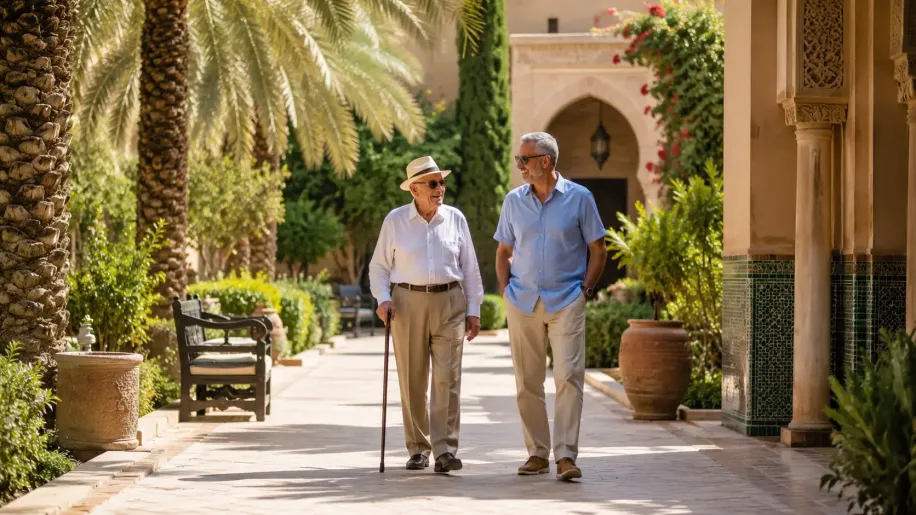
Marrakech tourism does not belong to a specific age group. People of any age can visit Marrakech throughout the year. However, when it comes to senior travel in Marrakech, the usual question arises, “Is Marrakech suitable for seniors?”
Well the answer is, “Yes.” With the right senior travel Marrakech planning around heat, terrain, and pacing. The city rewards travellers who move slowly and choose the right neighborhoods, but it can wear down anyone who tries to see everything on foot in a single day.
I have guided family members in their seventies through this city more than once, and the difference between a good trip and an exhausting one usually comes down to logistics, not stamina. This Marrakech senior travel guide focuses on what actually matters: real distances, real terrain, and a pace that holds up over several days.
What Makes Marrakech Challenging for Older Travellers
The main obstacle for Marrakech for older travellers is not the heat alone, though summer temperatures regularly exceed 38°C. It is the combination of uneven medina streets, sudden steps, motorbike traffic weaving through narrow alleys, and long stretches with no shade or seating.
The medina’s ground is a mix of worn cobblestone, packed dirt, and the occasional loose tile. Curbs are inconsistent, and many souk alleys narrow to less than a metre wide, which forces pedestrians to dodge carts and mopeds constantly. Knowing this in advance changes how you plan each day.
How Much Walking Is Required in Marrakech
How much walking is required in Marrakech depends entirely on your itinerary. A typical day exploring Jemaa el-Fnaa and the surrounding souks involves 5 to 8 kilometres of walking on uneven ground, often in direct sun. That distance adds up quickly for anyone with joint pain or reduced stamina.
By contrast, a day focused on Gueliz, Majorelle Garden, and the Yves Saint Laurent Museum involves closer to 2 to 3 kilometres, mostly on flat, paved sidewalks. The gap between these two experiences is significant, and choosing which type of day you want matters more than choosing which sights to see.
Getting Around: Transport for Comfortable Travel
Marrakech accessible travel relies heavily on private drivers and petit taxis rather than walking between every stop. Petit taxis are inexpensive, typically 20 to 40 dirhams for short rides within the city, and drivers are used to picking up and dropping off directly outside hotels and attractions.
For a full day of sightseeing, hiring a private driver for 400 to 600 dirhams removes the need to negotiate taxis repeatedly and allows drop-off as close as possible to each entrance. This single choice reduces daily walking distance more than any other planning decision.
Best Area to Stay in Marrakech for Seniors
The best area to stay in Marrakech for seniors is Gueliz or Hivernage, not the old medina itself. Both neighborhoods offer wide, flat, paved streets, modern hotels with working elevators, and easy taxi access without navigating the medina’s narrow alleys to reach your room each night.
Riads inside the medina are charming, but most were built centuries ago around narrow staircases with no elevator access. If you do choose a riad, confirm ground-floor rooms are available before booking, since upper floors often require climbing steep, narrow steps multiple times a day.
Easy Attractions and Things to Do With Limited Mobility
Easy things to do in Marrakech with limited mobility center on sites with flat paths, benches, and manageable distances between entrance and exit. The strongest options include:
- Majorelle Garden — paved paths throughout, benches at regular intervals, though it does draw large crowds by mid-morning
- Yves Saint Laurent Museum — fully indoor, air-conditioned, minimal walking between galleries
- Menara Gardens — flat, open grounds with wide paths and shaded seating near the water basin
- Marrakech Museum — ground-floor galleries with seating areas, housed in a restored 19th-century palace
- Bahia Palace — mostly single-level courtyards, though some sections include uneven stone flooring
What are the best things to do in Marrakech for seniors who generally avoid sites requiring stair climbs, such as tower viewpoints or upper-level terraces without elevator access.
Sites That Require More Caution
Not every landmark suits every traveller, and being direct about this matters. Are many parts of Marrakech Medina suitable for elderly travellers? Parts of it, yes, but the busiest souk alleys near Jemaa el-Fnaa involve crowded, uneven paths that can be genuinely difficult during peak afternoon hours.
The Saadian Tombs, for example, involve narrow entry corridors and small stone steps that are hard to manage for anyone using a cane or walker. Visiting early in the morning, before crowds build, makes these sites more manageable if you choose to include them.
Accessible Tours in Marrakech
Accessible tours in Marrakech have expanded significantly over recent years, with several operators now offering private, slow-paced itineraries built specifically around mobility needs. These typically include air-conditioned vehicles, drivers trained to identify step-free entrances, and flexible pacing rather than fixed group schedules.
Golf cart tours through parts of the medina have also become available, offering a middle ground between full walking tours and staying entirely in the car. Booking a private guide, rather than joining a large group tour, gives you far more control over pacing and rest stops throughout the day.
A Comfortable Marrakech Itinerary for Seniors
A comfortable Marrakech itinerary spread across four days, rather than compressed into two, keeps daily walking manageable while still covering the city’s essential sights.
Day 1 — Majorelle Garden in the morning, followed by lunch in Gueliz, then a slow afternoon at the Yves Saint Laurent Museum.
Day 2 — Private driver to Menara Gardens for a relaxed morning walk, followed by an early lunch and rest at the hotel during the hottest hours.
Day 3 — Bahia Palace and Marrakech Museum, both offering ground-floor access, visited before 11am to avoid both heat and crowds.
Day 4 — A short, guided medina walk focused only on Jemaa el-Fnaa’s edges and nearby spice stalls, with a private driver on standby nearby for an early exit if needed.
This structure keeps each day’s walking under 3 kilometres while still covering Marrakech’s most recognizable landmarks.
Tips for Slow Travel and Avoiding Fatigue
Marrakech slow travel works best when built around a few consistent habits rather than a packed schedule. Practical adjustments that make a real difference:
- Schedule outdoor activities before 11am or after 4pm, avoiding peak midday heat
- Build in a two to three hour rest period during the hottest part of the afternoon
- Carry water at all times, since shaded seating is limited in the souks
- Choose restaurants with seated, air-conditioned interiors rather than open-air terraces during summer months
- Confirm elevator access at your hotel before booking, not after arrival
Marrakech Over 60 Travel: What to Expect Realistically
Marrakech over 60 travel does not require avoiding the medina entirely, but it does require accepting that some sections are simply harder to reach comfortably. Planning two or three shorter medina visits, rather than one long day, keeps fatigue and joint strain manageable across the full trip.
Marrakech for elderly tourists traveling with a companion should also plan buffer time between each activity, since Moroccan taxi and driver schedules can shift slightly depending on traffic through the city center.
Final Thoughts
Marrakech for travellers with mobility issues is absolutely possible with the right combination of private transport, flat-terrain attractions, and a slower daily pace. The city’s charm does not require walking every alley in the medina, and some of its most memorable sights, like Majorelle Garden and the Yves Saint Laurent Museum, are also among its most accessible.
Plan around heat and terrain first, then build your sightseeing list second. That order makes the difference between a trip that feels manageable and one that feels rushed.
FAQs
Is Marrakech Medina suitable for elderly travellers?
Parts of it are manageable, especially early morning visits to main squares. Narrow souk alleys and uneven stone paths are harder to navigate during crowded afternoon hours.
What are the best things to do in Marrakech for seniors?
Majorelle Garden, the Yves Saint Laurent Museum, Menara Gardens, and Marrakech Museum offer flat terrain, seating, and manageable distances between stops.
What is the best Marrakech itinerary for older travellers?
A four-day pace with roughly 2 to 3 kilometres of walking per day, private transport between sites, and a midday rest period during peak heat.
Is there a Marrakech itinerary without too much walking?
Yes, focusing each day on one or two nearby attractions with private driver transport keeps daily walking under 3 kilometres total.
What should travellers with mobility issues know before visiting Marrakech?
Confirm elevator access at hotels, avoid sites with narrow stone stairs like the Saadian Tombs, and hire private transport rather than relying on walking between sights.
What should over-60 travellers know before visiting Marrakech?
Splitting medina visits into shorter sessions, scheduling around midday heat, and choosing Gueliz or Hivernage for accommodation all reduce physical strain significantly.


