



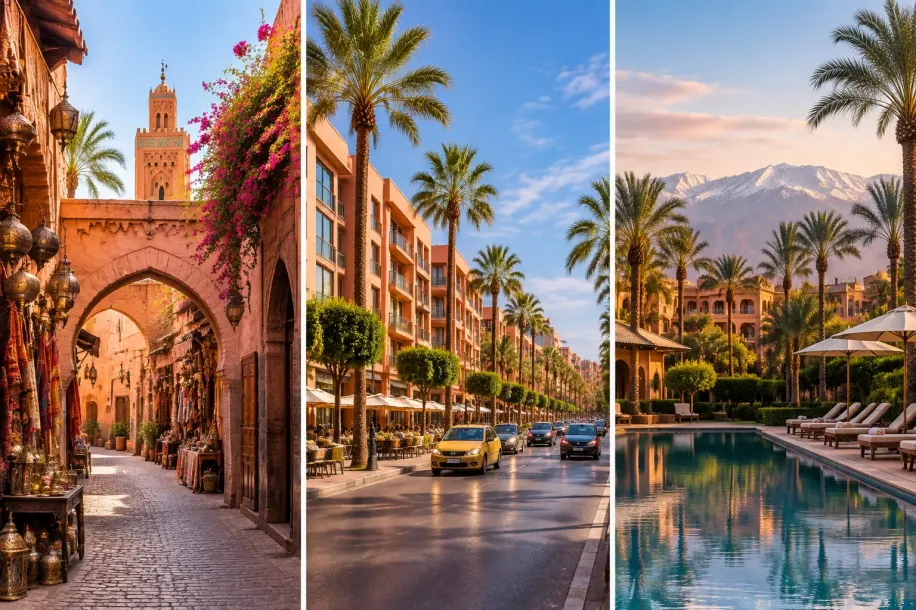
Almost every argument about Marrakech accommodation comes down to one question that booking sites never ask you. How do you want your evenings to end? If the answer is a rooftop above the old rooftops with the call to prayer carrying across the terraces, you belong in the old city. If it is a table on a wide pavement with a glass of wine and a taxi outside, you do not.
That single question settles most of the Medina vs Gueliz vs Hivernage debate faster than any list of pros and cons. The three districts sit within a few kilometres of each other, so nothing is far away in distance terms. What separates them is texture. One is a walled UNESCO city of alleys where cars cannot reach your door. One is a grid of boulevards, cafes and galleries built in the twentieth century. One is a compact strip of large hotels, spas and late-night venues between the two.
This Marrakech accommodation guide compares the three on the things that actually change your holiday, including price, noise, walking distances, food, nightlife, luggage access and who each area suits. Prices quoted are approximate and move with season, demand and booking method.
The Short Answer
- Medina. Choose it for atmosphere, riads, souks and being able to walk to the monuments. Accept noise, alleys, stairs and a taxi drop-off that is not at your door.
- Gueliz. Choose it for value, restaurants, cafes, galleries and easy street access. Accept that the old city is a fifteen-minute taxi or a half-hour walk away.
- Hivernage. Choose it for quiet streets, hotel pools, spas and nightlife within walking distance. Accept higher room rates and less local character.
| Area | Best for | Typical nightly rate | Atmosphere |
| Medina | First-timers, couples, culture and souks | Hostel beds from around 150 MAD, mid-range riads roughly 600 to 1,200 MAD, luxury riads far higher | Dense, historic, noisy in places, no cars |
| Gueliz | Value, food, longer stays, repeat visitors | Budget hotels and apartments from roughly 300 to 500 MAD, boutique stays from around 700 MAD | Modern grid, wide pavements, cafe culture |
| Hivernage | Comfort, families with pools, nightlife, mobility needs | Four and five star hotels commonly from around 1,000 MAD upward | Quiet, green, hotel-led, low street life |
Rates reflect commonly advertised ranges rather than fixed prices. Expect sharp rises around Easter, October, Christmas and New Year, and better value in July and August when the heat thins demand.
The Medina: Atmosphere First, Convenience Second
The Medina is the walled old city, founded in the eleventh century and inscribed on the UNESCO World Heritage list in 1985. Roughly 700 hectares of lanes, souks, courtyard houses and monuments sit inside the ramparts, with Jemaa el-Fnaa at the centre and the Kasbah quarter and the Saadian Tombs to the south.
Staying here means staying in a riad. These are courtyard houses turned into small hotels, usually four to ten rooms, often with a plunge pool downstairs and a terrace on top. Breakfast on that terrace is the reason most people book. The riads in the Medina range from simple guesthouses to restored palaces, and the price gap between them is enormous.
The trade-offs are real and worth knowing in advance. Taxis cannot enter most alleys, so you will be dropped at the nearest gate and walk the last few minutes, sometimes with a porter and a cart for your luggage. Riads are old buildings with narrow staircases and rarely have lifts. Sound carries between terraces, mopeds run through the lanes until late, and the dawn call to prayer is part of the deal. Most riads do not serve alcohol, though many will not mind if you bring your own.
Location inside the walls matters more than most visitors realise. Around Jemaa el-Fnaa you get convenience and constant noise. The northern souk quarters are atmospheric and easy to get lost in. Bab Doukkala, the Mellah and the Kasbah are quieter, still walkable to the square in ten to fifteen minutes, and usually cheaper for the same standard of room.
Gueliz: The New City for Food, Value and Easy Days
Built from the 1910s as the French colonial new town, Gueliz is a normal working city district. Streets are wide and signposted, taxis stop outside your door, supermarkets and pharmacies are on the corner, and the pavements are flat. Avenue Mohammed V runs straight down to the Koutoubia, which makes the old city a walk of roughly twenty five to thirty minutes or a short taxi ride.
This is where the city eats. The concentration of bistros, bakeries and cafes is higher here than anywhere else in Marrakech, and mid-range dinners with wine typically land around 200 to 350 dirhams per person. Licensed bars are ordinary rather than an event, which matters if you like a drink with dinner. Shopping runs from the covered Marche Central to M Avenue, and the Jardin Majorelle with the Yves Saint Laurent museum sits on the northern edge of the district.
Answering whether it is better to stay in Medina or Gueliz depends mostly on trip length. For two or three nights, the old city wins because your sightseeing is on the doorstep. For a week or more, Gueliz usually wins on comfort, price and the quality of everyday meals. It is also the obvious base for remote workers, given the coworking spaces clustered here and the number of apartment rentals.
Hivernage: Quiet Streets, Pools and Late Nights
Wedged between Gueliz and the medina walls, Hivernage is the smallest of the three and the most deliberately calm. It was laid out as a garden district and still feels like one, with jacaranda-lined avenues, walled hotel grounds and very little street commerce. If you have wondered whether Hivernage is a good area to stay in Marrakech, the honest answer is yes for comfort and no for local colour.
The accommodation here is mostly large four- and five-star hotels with pools, spas, gyms, lifts and staffed reception desks, which is exactly what some travellers want, and others find impersonal. The Koutoubia and the edge of the old city are a fifteen to twenty minute walk away, and the Palais des Congrès and Menara Mall sit close by on Avenue Mohammed VI.
It is also the centre of the city’s late scene. The big clubs, casino, lounge restaurants and hotel bars are within walking distance of each other, which removes the awkward taxi hunt at two in the morning. Expect nightlife prices to match, with cocktails at high-end venues commonly around 150 to 200 dirhams and weekend club entry sometimes reaching 200 dirhams. That makes this the best area to stay in Marrakech for nightlife by a clear margin, and a poor choice if you want to fall asleep to something other than a bassline on a Saturday.
Which Area of Marrakech Is Best for Your Trip?
The best area to stay in Marrakech changes completely with the kind of traveller you are.
- First visit of three or four nights. The old city. You will spend your days at the souks, Bahia Palace, Ben Youssef Madrasa and Jemaa el-Fnaa, and walking home beats two taxis a day. This is the answer to where should I stay in Marrakech for the first time.
- Couples. A small riad in a quiet medina quarter, or a garden hotel in Hivernage if you want a spa and a pool. Both work, and the romantic stays in each district feel very different from one another.
- Families with young children. Hivernage or a Gueliz apartment. Pools, lifts, pushchair-friendly pavements and a fridge for snacks outweigh atmosphere when you are travelling with toddlers.
- Food-led trips. Gueliz, comfortably the best area to stay in Marrakech for restaurants, with the old city’s rooftop dining reachable in minutes by taxi.
- Nightlife. Hivernage, with Gueliz as the cheaper alternative for bars rather than clubs.
- Quiet sleepers. Hivernage away from the club strip, or the Mellah and Kasbah inside the walls. That is the realistic answer for the best quiet area to stay in Marrakech.
- Older travellers or limited mobility. Gueliz or Hivernage. Flat streets, lifts and door-to-door taxis make an enormous difference, as the guide to visiting Marrakech as a senior covers this in more detail.
- Stays of a week or more. Gueliz, or an apartment rental on its quieter edges, where nightly rates drop, and daily life gets simpler.
Moving Between the Three Districts
None of these areas is far from the others. Budget a few minutes and a few dirhams rather than half an hour and a plan.
| Route | On foot | By petit taxi |
| Gueliz to Jemaa el-Fnaa | 25 to 30 minutes down Avenue Mohammed V | Roughly 20 to 40 MAD by meter |
| Hivernage to the Koutoubia | 15 to 20 minutes | Roughly 20 to 30 MAD |
| Gueliz to Hivernage | 10 to 15 minutes | Roughly 20 to 30 MAD |
| Airport to any of the three | Not walkable | Regulated fare, commonly 100 to 150 MAD by day and higher after dark |
Petit taxis are metered by law, and most central journeys sit between 15 and 40 dirhams, with official night rates around fifty percent higher. If a driver refuses the meter, agree the fare first or take the next car. Ride hailing is an easy alternative since Uber returned to Marrakech in late 2025, and it removes the negotiation entirely.
What Nobody Tells You Before Booking
- Your luggage decides more than you think. If you are arriving with large suitcases and a late flight, a riad down a dark lane is a harder first hour than a hotel with a lobby. Ask your riad to arrange a porter and a pin location before you fly.
- Distance to the square is not the same as walking time. Two riads listed as 400 metres from Jemaa el-Fnaa can be five minutes apart in practice, because one route runs down a straight lane and the other loops through the souks.
- Alcohol is a district issue. Licensed venues cluster in Gueliz and Hivernage, and most medina riads and small restaurants do not serve it. Plan the evenings you want rather than being surprised on night one.
- Winter nights are genuinely cold. Riad courtyards hold the cold beautifully in summer and unpleasantly in January. Check for heating rather than assuming air conditioning units will do the job.
- Rooftop terraces cut both ways. A neighbouring restaurant terrace with live music is charming from your table and less charming from your pillow. Ask which side of the building your room sits on.
- Fridays run differently across the whole city, with a quieter midday and a busier late afternoon. Reading up on how Friday changes the rhythm saves you a wasted morning of closed doors.
- Splitting your stay works well on trips of five nights or more. Two or three nights in a riad for the atmosphere, then a hotel in the new city for the pool and the restaurants, gives you both experiences without a long transfer between them.
Booking Mistakes to Avoid
- Booking on photographs alone. Courtyard shots look identical across every price band, so read the location detail and the access description instead.
- Assuming a hotel address inside the walls means a car can reach it. Confirm the drop-off point and how far you walk from it.
- Choosing the old city for a business trip or a workation, then losing an hour a day to alleys and patchy wifi.
- Picking a nightlife hotel and expecting silence. If you want both, book in Hivernage but ask for a room away from the venue side.
- Leaving airport transfers to chance at night, when fares rise and queues build. Pre-book if you land late.
- Overlooking whether you want a riad or a hotel at all. That choice often matters more than the district, and the comparison of a riad against a hotel is the fastest way to settle it.
Expert Tips for Choosing Your Base
- Book by evening, not by daytime. Daytime sightseeing is the same wherever you sleep. Evenings are what differ, and they are what you are really choosing.
- Check the micro-location, not the district. A quiet lane in the Mellah and a room above a souk are both in the Medina, and they are not remotely the same stay.
- Carry cash for your first day. Riad deposits, porters, taxis and small restaurants often want dirhams, and cash machines are scarce deep in the alleys.
- Book early for spring and autumn. March to May and September to November are the busiest months, and the best riads and hotels sell out first. Rates across the city have been climbing year on year, so early booking is worth real money.
- Use the old city for a hammam, not a spa. A traditional hammam inside the walls costs a fraction of a hotel spa treatment and is a better story.
- Eat where you are not sleeping. Take a taxi across the city at least twice. A rooftop dinner over the old city and a long lunch in the new one are both worth the fare.
Frequently Asked Questions
Which area of Marrakech is best for tourists?
For a first short visit, the old city, because the main sights are within walking distance. For longer stays, comfort or families, Gueliz and Hivernage generally work better.
Is Gueliz better than the Medina in Marrakech?
It is better for food, value, accessibility and everyday convenience. It is worse for atmosphere and proximity to the monuments. Neither wins outright, so it depends on what your days look like.
Is Hivernage worth the extra cost?
If you want a pool, a spa, a lift, quiet streets and nightlife on your doorstep, yes. If you want souks, riads and local street life, you are paying for things you will not use.
Which is the safest area to stay in Marrakech?
All three are used by visitors year-round, and the usual city precautions apply. The practical difference is at night, when the wide, lit streets of Gueliz and Hivernage feel easier to navigate than unfamiliar medina alleys.
How far is Gueliz from Jemaa el-Fnaa?
About two kilometres, which is a twenty-five to thirty-minute walk down Avenue Mohammed V or a short metered taxi ride.
Can taxis reach riads inside the Medina?
Usually not to the door. Taxis stop at the nearest gate or square, and you walk the last stretch. Most riads will send someone to meet you if you give them an arrival time.
Where should families with children stay?
Hivernage for hotel pools and easy pavements, or a Gueliz apartment for space and a kitchen. Riads suit families with older children who can manage stairs and narrow lanes.
Is it worth splitting a stay between two areas?
On trips of five nights or more, yes. The districts are ten to twenty minutes apart, so moving costs you one short taxi ride and gives you two very different sides of the city.
Making the Final Call
Comparing Medina vs Gueliz vs Hivernage gets easier once you stop looking for the best area and start looking for the right one. Short first trip built around souks and palaces, book the old city and accept the noise. Longer stay, a food-led holiday or a base you will actually live in, book the new city. Comfort, a pool, a spa and late nights, book Hivernage and enjoy the quiet mornings.
Whichever you choose, pick the micro-location carefully, confirm how you reach the door with your bags, and remember that the other two districts are never more than a short ride away. When you are ready to narrow things down, compare the city’s hotels and riads side by side, and read the wider guide on where to stay in Marrakech before you book.


